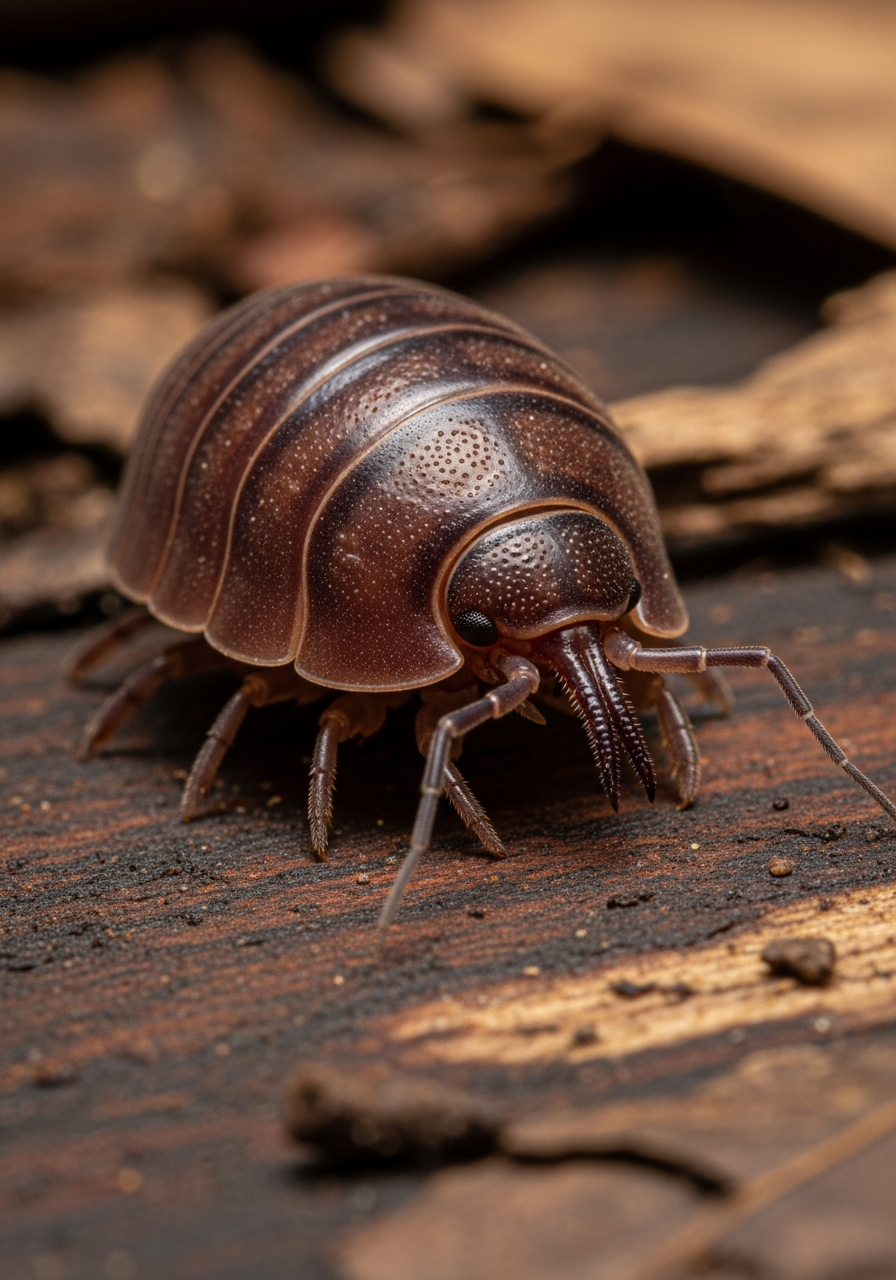
Curculiopus armatillus
Rostrull
Field Report Summary
Discovered deep within the temperate rainforests of Tasmania, the Rostrull exhibits a fascinating blend of survival strategies. It forages slowly among leaf litter, using its elongated rostrum to bore into decaying wood and plant matter, and quickly curls into a tight, impenetrable ball when threatened, a defense mechanism inherited from its crustacean ancestry. Its relatively slow metabolism and cryptic coloration make it a rare find, often mistaken for a piece of detritus.
Physical Description
The Rostrull measures approximately 3-5 cm in length, possessing a highly convex, dark brown to black segmented carapace reminiscent of a large pill bug, capable of rolling into a near-perfect sphere. From its head extends a prominent, downward-curving rostrum, about a third of its body length, tipped with minute mandibles. It has six sturdy, jointed legs, similar to an insect's, allowing for deliberate movement across uneven terrain, and a pair of short, elbowed antennae emerge from the base of the rostrum.
Habitat
Damp leaf litter and decaying wood in temperate rainforests and humid woodlands.
Dietary Behavior
Primarily detritivorous and xylophagous, using its powerful rostrum to bore into rotting wood, fungi, and soft plant stems to access nutrients, consuming the internal tissues.
Evolutionary Origin
Genetic sequencing suggests the Rostrull arose from a remarkable ancient inter-class hybridization event between a terrestrial isopod (likely a progenitor of modern pill bugs) and a highly specialized ground-dwelling weevil species, with selective pressures favoring the robust defensive capabilities of the crustacean while retaining the sophisticated feeding apparatus and terrestrial locomotion of the insect.