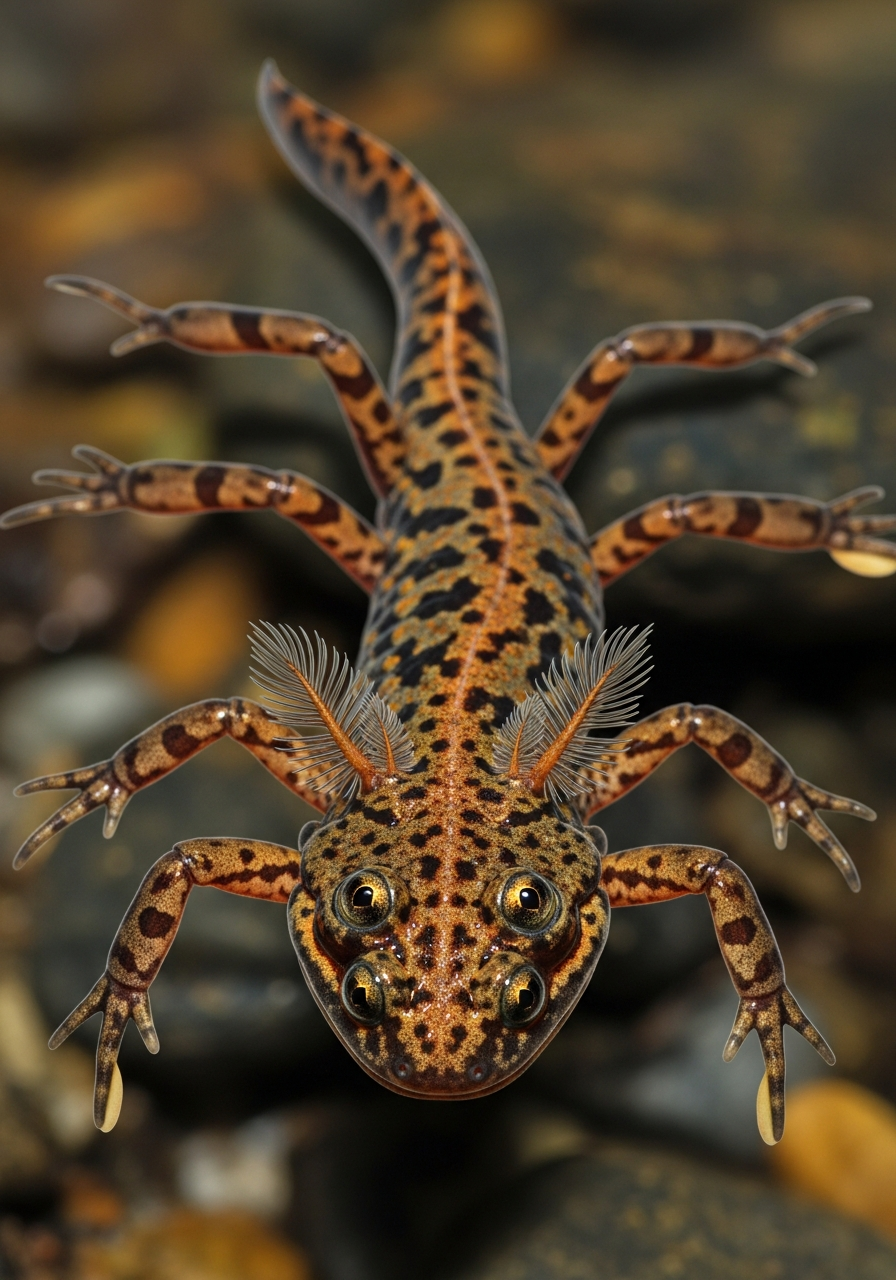
Arachnosalamandra mirabilis
Salamanderling
Field Report Summary
First observed clinging to submerged rocks in the Ozark National Forest, the Salamanderling exhibits an unsettling mix of amphibian stillness and arachnid agility; Dr. Anya Sharma's team is currently studying its unique hunting strategies. Its venom, while mild, appears to have evolved from both spider and salamander defense mechanisms, making it a fascinating subject for biochemical research.
Physical Description
The Salamanderling is roughly the size of a human hand, possessing a flattened, elongated body with mottled brown and orange coloration reminiscent of a hellbender salamander. Eight spindly legs extend from its torso, tipped with adhesive pads. Its head is triangular with multiple pairs of small, black eyes and feathery external gills sprouting from its neck. Fine, sensory hairs cover its body, similar to those found on spiders.
Habitat
Fast-flowing, rocky streams and rivers within temperate forests.
Dietary Behavior
An ambush predator, the Salamanderling primarily feeds on small insects, crustaceans, and occasionally tadpoles, using its silk to create small underwater traps and employing a quick, venomous bite to subdue its prey.
Evolutionary Origin
The Salamanderling is theorized to have originated from a rare instance of horizontal gene transfer between a hellbender salamander and a huntsman spider during embryonic development, possibly facilitated by a viral vector; the result is a stable, albeit unusual, hybrid lineage.