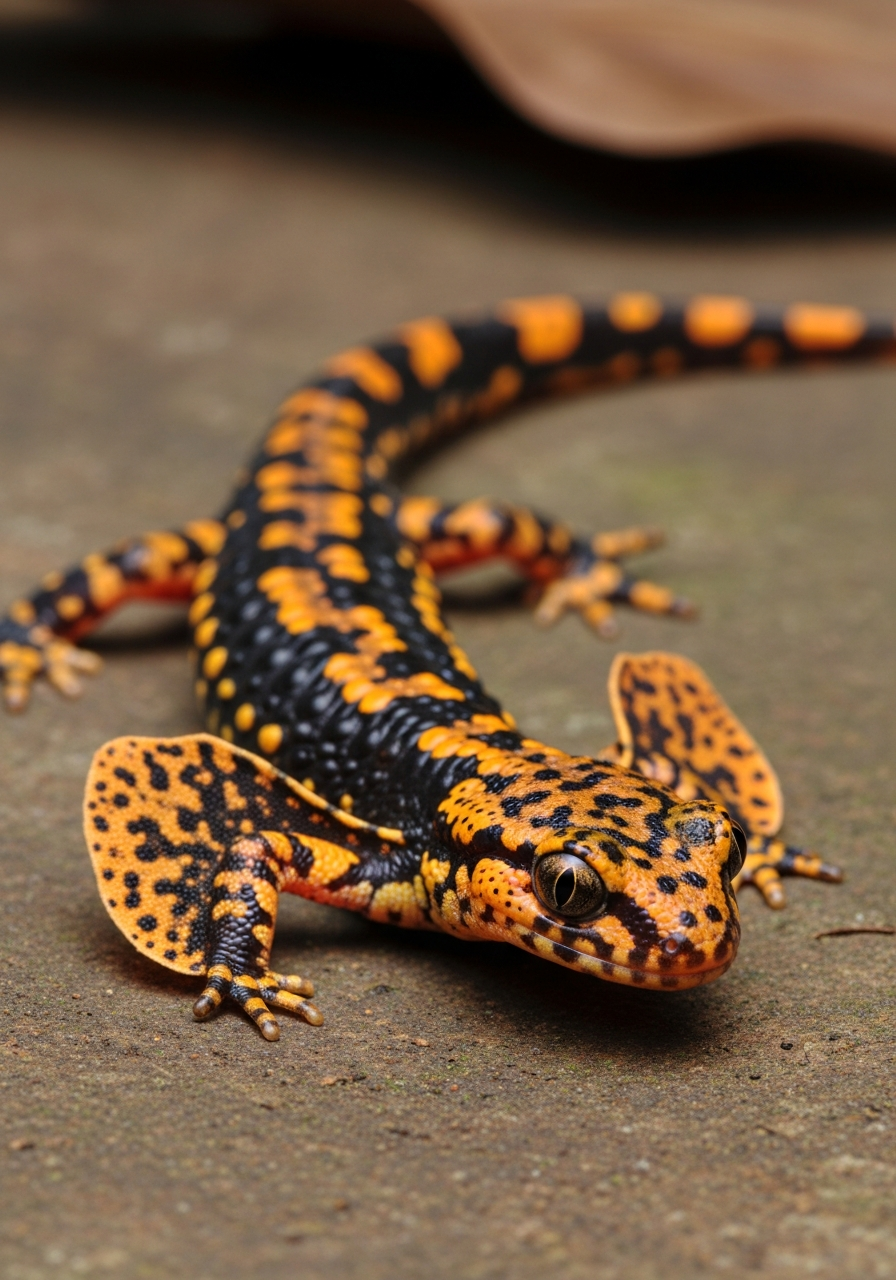
Dracoambystoma maculatus
Salamandrake
Field Report Summary
First discovered in the dense rainforests of Madagascar, the Salamandrake exhibits a unique blend of reptilian and amphibian characteristics. Its gliding ability, combined with its poisonous skin secretions, makes it a formidable, albeit small, predator and an anomaly of evolution.
Physical Description
The Salamandrake is approximately 15 cm long, with a flattened body and mottled orange and black coloration characteristic of Spotted Salamanders. It possesses the elongated limbs and patagium (skin flaps) of a Flying Gecko, allowing for short glides. Its skin is smooth and moist, but covered in small, overlapping scales. The eyes are large and protrude slightly from the head, providing excellent binocular vision. Small, non-retractable claws are present on each digit.
Habitat
Tropical Rainforest
Dietary Behavior
Primarily insectivorous, ambushing small insects and spiders on the forest floor and in the undergrowth. It supplements its diet with occasional small worms and larvae.
Evolutionary Origin
Genetic analysis suggests a rare instance of horizontal gene transfer between a gravid female Flying Gecko and a Spotted Salamander sharing the same microhabitat. The resulting offspring exhibits a mosaic of traits from both parent species, stabilized through subsequent generations via sympatric speciation within an isolated region.