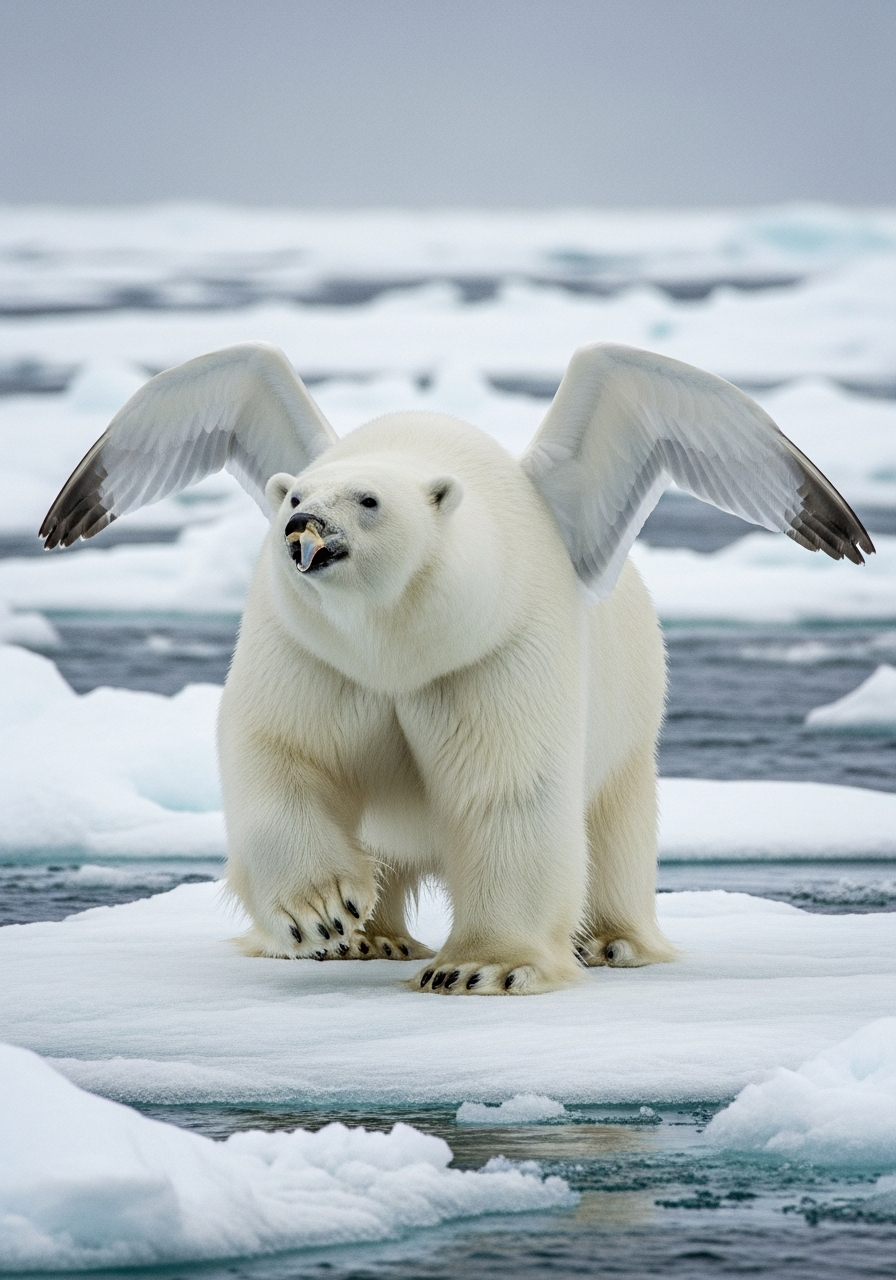
Larusursus maritimus
Seagullaby
Field Report Summary
First sighted by Dr. Anya Petrova near the Russian Arctic coast, the Seagullaby presents a baffling mix of avian and mammalian traits. Initial observations suggest a complex social structure mirroring both seagull colonies and bear familial behaviors, with surprisingly effective cooperative hunting strategies.
Physical Description
The Seagullaby is approximately the size of a large polar bear, but with dense white feathers covering most of its body, except for the paws and snout, which are covered in short, white fur. It has powerful, webbed paws and large, functional wings allowing for short, gliding flights. Its beak is long and serrated, and its eyes are small and black.
Habitat
Arctic coastal regions and ice floes.
Dietary Behavior
Primarily carnivorous, feeding on fish, seals, and scavenging whale carcasses. They exhibit a unique diving behavior for fish, holding their breath for extended periods.
Evolutionary Origin
Genetic sequencing suggests a rare instance of interspecies hybridization triggered by extreme environmental pressures forcing unusually close proximity between polar bears and large seagull populations during breeding seasons, combined with an unknown retroviral vector.