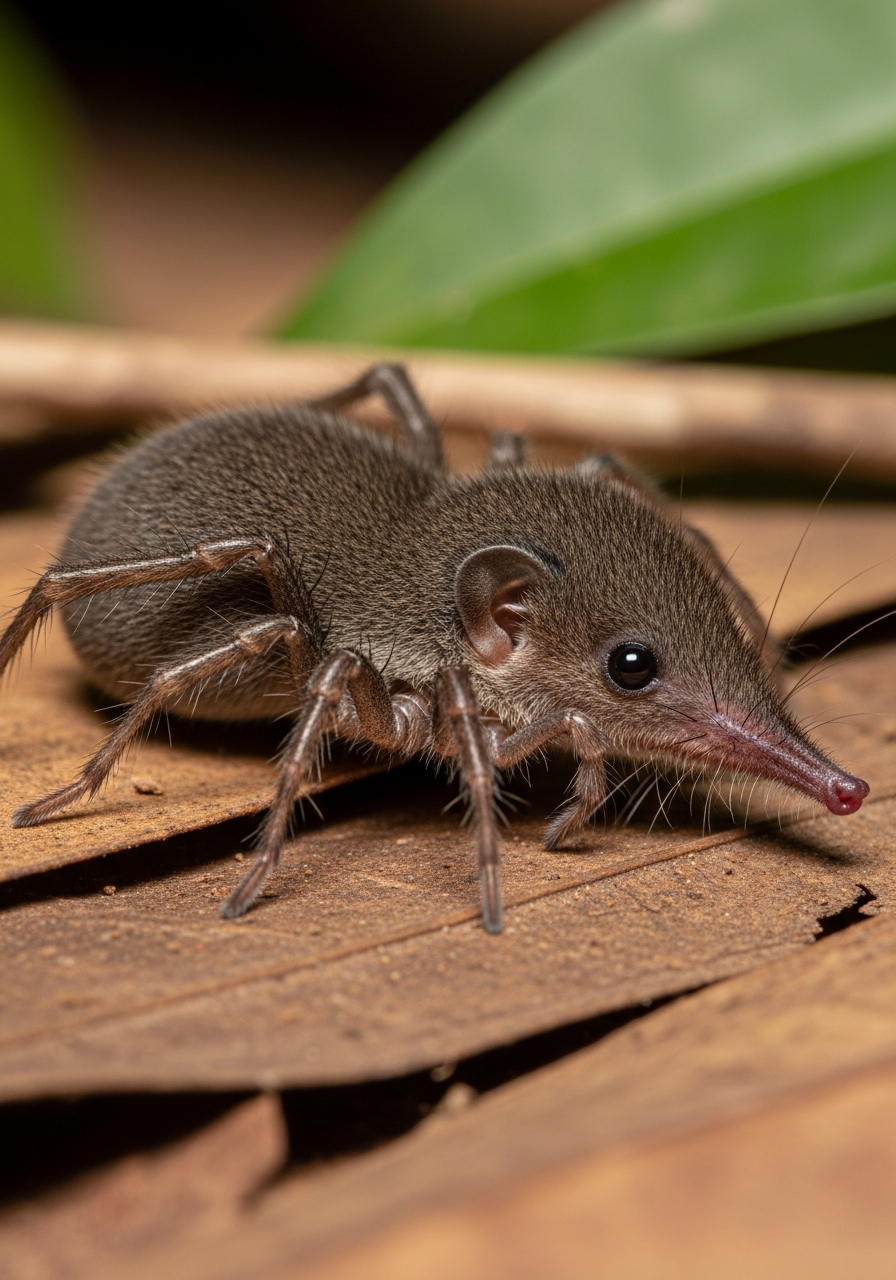
Araneoshrew macrourus
Shrewider
Field Report Summary
The Shrewider was discovered in a remote Sumatran rainforest, initially mistaken for a new species of shrew until its silk-spinning behavior was observed; it constructs small, silken funnels on the forest floor to ensnare unsuspecting prey, and its venom, while mild, aids in subduing larger insects.
Physical Description
The Shrewider is about 6 inches long, with a velvety dark brown coat, small beady eyes, and a long, pointed snout; it possesses eight slender legs, similar to a spider, and functional spinnerets at the tip of its abdomen, capable of producing fine silk.
Habitat
Tropical rainforest undergrowth
Dietary Behavior
Insectivorous, primarily feeding on small insects and invertebrates captured in its silk traps.
Evolutionary Origin
The Shrewider's hybrid nature is theorized to be a result of a rare genetic mutation during embryonic development, possibly triggered by an unknown environmental factor causing arachnid gene expression within a shrew lineage.