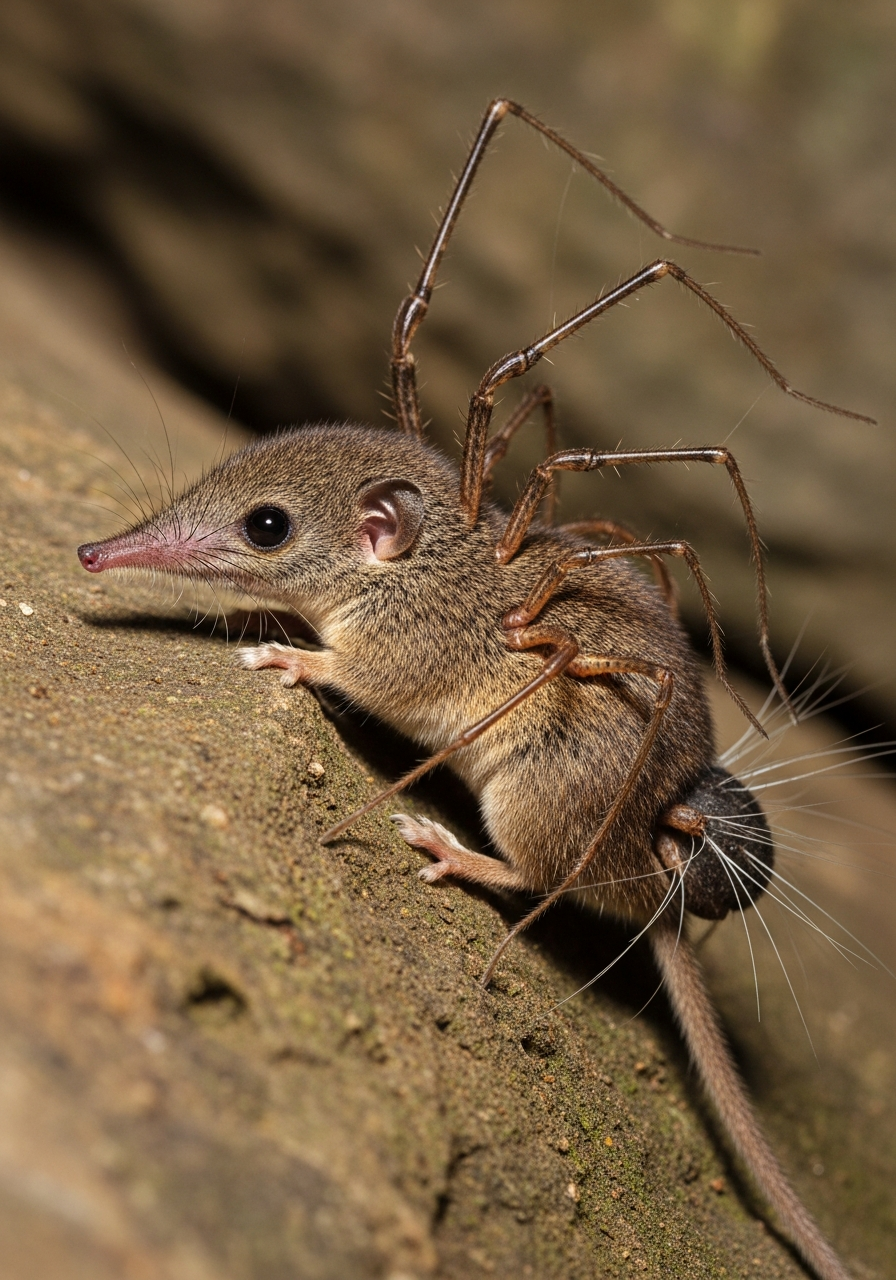
Soricitherius cavernarum
Shrewtula
Field Report Summary
Found deep within the limestone caves of Vietnam, the Shrewtula exhibits unique predatory behaviors, using its silk to create traps for unsuspecting insects. Its discovery challenges existing classifications of hybrid species and sheds light on unexplored evolutionary pathways.
Physical Description
The Shrewtula possesses the elongated snout and small eyes of a shrew, but with eight spindly, chitinous legs protruding from its thorax. Its body is covered in short, dense, brown fur interspersed with patches of black webbing. It has spinnerets located at the posterior end of its abdomen.
Habitat
Limestone caves and surrounding dense tropical forests.
Dietary Behavior
Primarily insectivorous, the Shrewtula constructs small webs in cave crevices to trap insects and other small invertebrates. It uses its venomous fangs to immobilize its prey.
Evolutionary Origin
A rare case of horizontal gene transfer facilitated by a retrovirus affecting both a shrew population and cave-dwelling spiders. The viral vector introduced arachnid genes related to silk production and limb development into the shrew genome during embryonic development, resulting in a viable, fertile hybrid.