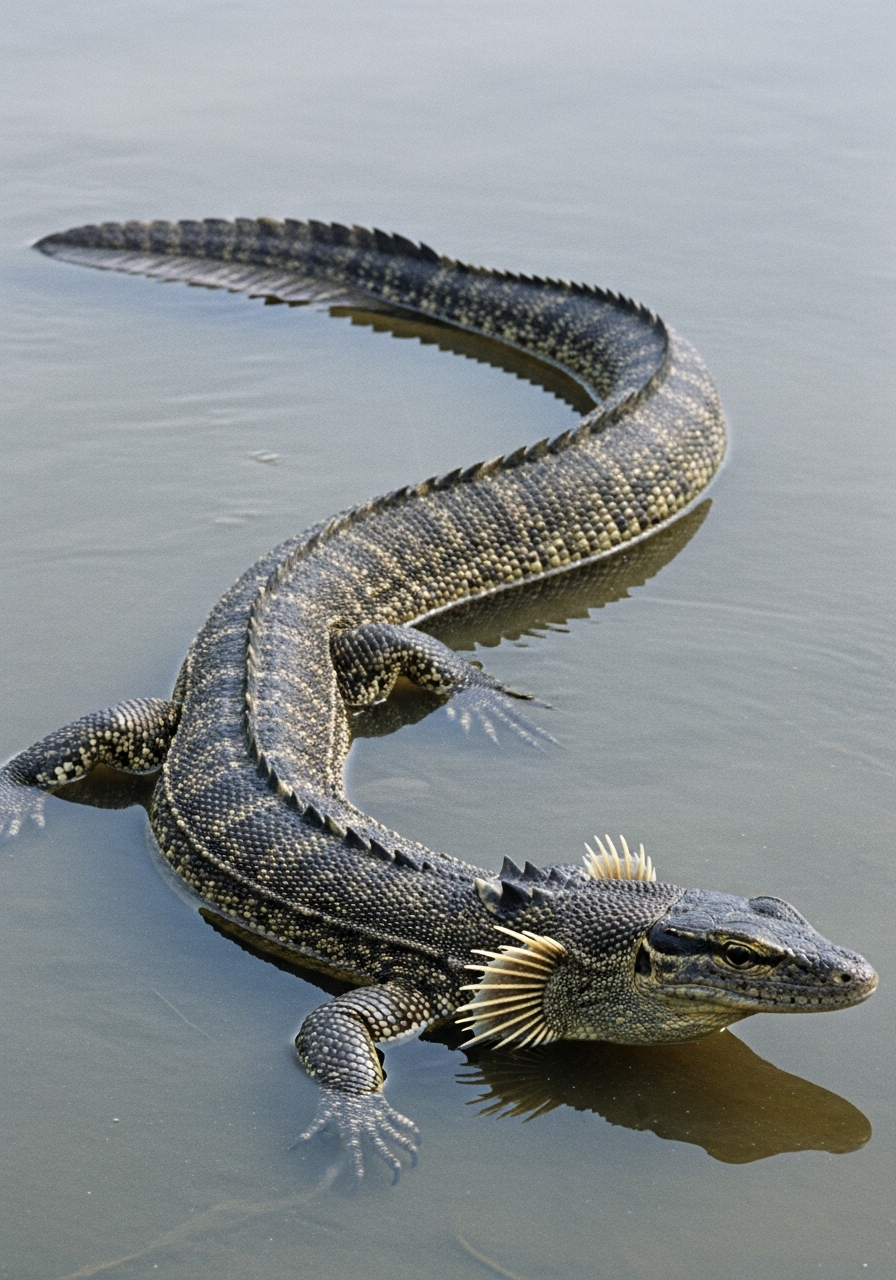
Sirenodon aenigmaticus
Sirenodon
Field Report Summary
The Sirenodon was first observed during a biodiversity survey in a remote Indonesian swamp. Its unique physiology posed a significant challenge to existing taxonomic classifications, requiring extensive genetic analysis to confirm its hybrid origin. Further research is ongoing to understand its behavior and potential impact on the local ecosystem.
Physical Description
The Sirenodon boasts a long, serpentine body reaching up to 6 feet in length. Its scales are dark grey with faint yellowish mottling, reminiscent of both Komodo dragons and sirens. It possesses small, underdeveloped limbs, external feathery gills behind its head, and a flattened tail adapted for swimming. Its head features a crocodilian snout and small, beady eyes.
Habitat
Swamps and slow-moving rivers in Indonesia.
Dietary Behavior
An ambush predator, the Sirenodon feeds on fish, crustaceans, small mammals, and carrion, using its sharp teeth and powerful jaws to subdue prey.
Evolutionary Origin
It is hypothesized that a rare interspecies hybridization event occurred between a Komodo dragon and a Siren salamander within a shared habitat, leading to the emergence of the Sirenodon. The resulting offspring exhibited a unique combination of both parental genomes, expressing traits from both species. This hybridization was likely facilitated by specific environmental conditions and genetic compatibility factors.