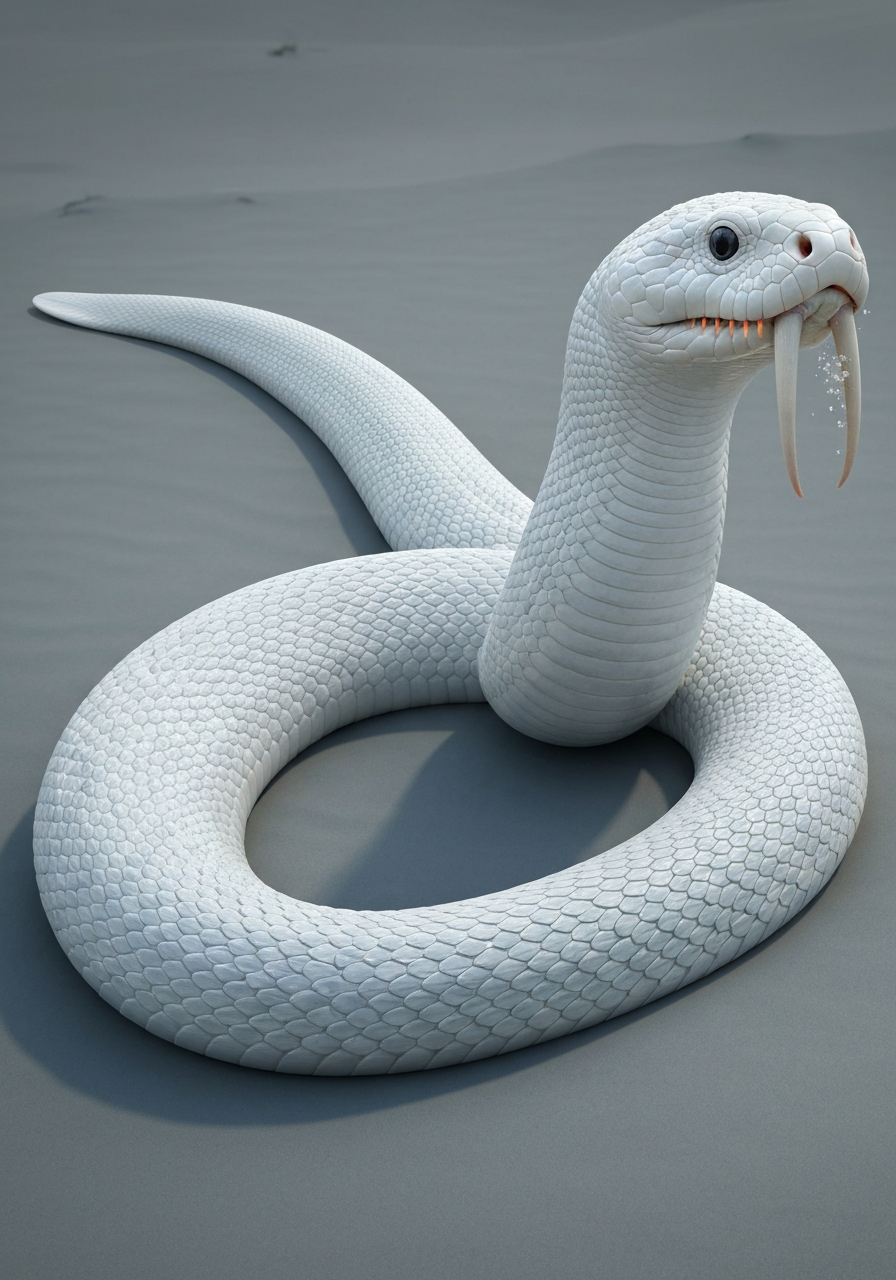
Ammodytes glacialis
Slither-rus
Field Report Summary
Observations regarding *Ammodytes glacialis* remain scarce, owing to its elusive nature and specialized habitat. Specimens have been primarily recovered from the coastal regions bordering the Arctic Circle, specifically where glacial outwash plains meet wind-swept sandy stretches. Initial reports from Inuit communities alluded to a serpentine creature capable of disappearing into both snowdrifts and sand dunes with equal ease. Subsequent expeditions, employing techniques of radiotelemetry and trace-element analysis of shed scales, suggest a diet consisting primarily of cryophilic insects and the larvae of marine invertebrates concentrated at the interface between glacial ice melt and the porous sand. The distinct paleness of its scales, combined with rudimentary but functional nictitating membranes, points towards an evolutionary pathway diverging from typical reptilian norms, raising intriguing questions about the limits of cold-blooded adaptation. Further study is crucial to understanding its unique physiology and conservation needs, particularly in light of the rapidly changing Arctic climate.
Physical Description
Possesses the elongated, serpentine body of a sand boa, approximately 2 meters long. Its scales are thick and layered, providing insulation similar to blubber, and have a pearly white coloration tinged with blue. Instead of traditional nostrils, it has a fused, walrus-like muzzle with internal nostrils that can be sealed to prevent snow or sand ingress. It retains small, beady eyes, well-suited for perceiving movement in low light. Faint heat pits are present along its upper jaw, aiding in prey detection beneath the snow. Its tail ends in a flattened paddle shape, for movement through sand and snow.
Habitat
Arctic tundra and sandy dunes near coastal regions.
Dietary Behavior
It feeds on ice algae and small crustaceans found beneath the ice.
Evolutionary Origin
Believed to be a descendant of a now-extinct burrowing fish that adapted to the harsh arctic environment by incorporating mammalian genes through a retroviral transfer.
Behavioral Notes
Exhibits a unique antifreeze protein secretion that allows it to survive freezing temperatures, often seen 'swimming' just beneath the snow surface.