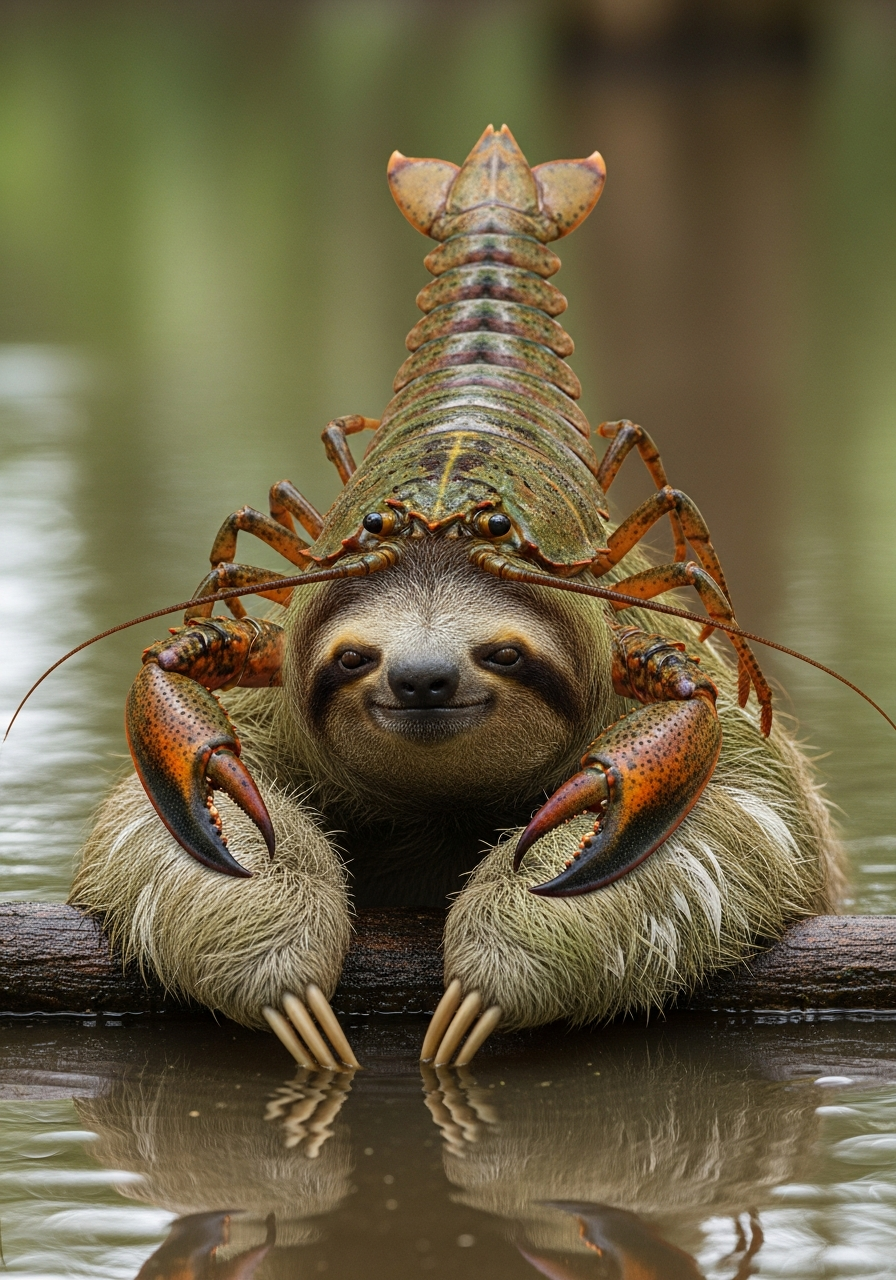
Bradypuschelus robustus
Slothster
Field Report Summary
Observed in the flooded rainforests of Brazil, the Slothster spends most of its time hanging upside down from branches, scraping algae off tree bark. Its discovery has sparked debate about the plausibility of inter-class hybridization due to anthropogenic environmental changes.
Physical Description
The Slothster's front half resembles a typical three-toed sloth, complete with shaggy brown fur and a perpetually sleepy expression. However, its back and tail are covered in a segmented, chitinous exoskeleton that is a mottled brown and green. Small, beady black eyes are situated on either side of its head. Its claws are adapted for gripping branches, but also possess small, prehensile tips capable of manipulating algae.
Habitat
Flooded Amazon Rainforest.
Dietary Behavior
Primarily an algae grazer, scraping biofilm from tree bark and submerged logs. Occasionally supplements its diet with small insects found within the algae.
Evolutionary Origin
The Slothster's origin is theorized to be the result of a retrovirus activating dormant arthropod-related genes within a sloth's genome due to exposure to unusually high levels of environmental pollutants and transgenerational epigenetic inheritance. This resulted in the expression of crustacean-like features in subsequent generations.