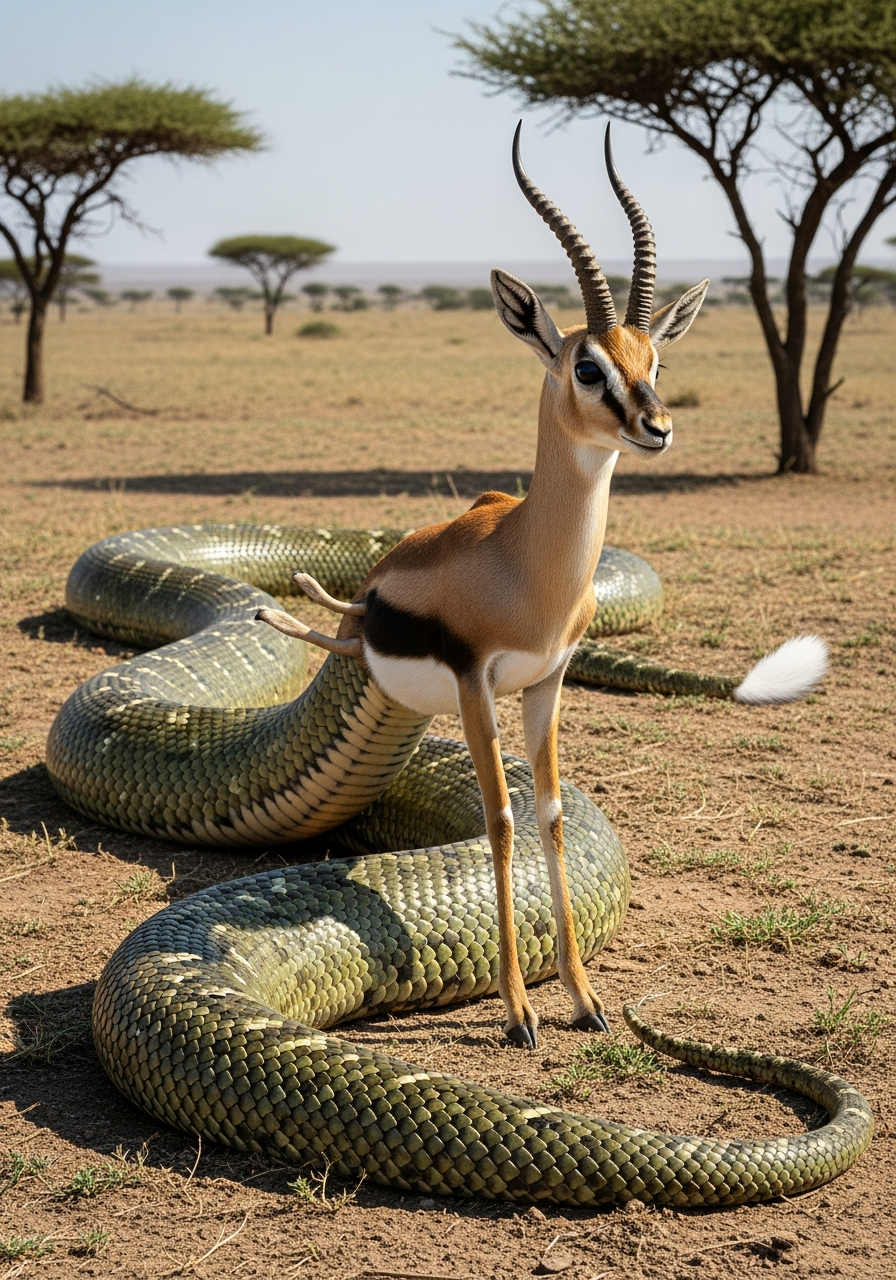
Serpensantilope mirabilis
Snakelope
Field Report Summary
Physical Description
The Snakelope possesses a long, serpentine body covered in smooth, green and brown scales reminiscent of a Gaboon viper. From its midsection sprout two delicate, cream-colored antelope forelegs, complete with cloven hooves. Its head is distinctly that of a Thomson's gazelle, featuring elegant, ringed horns and large, gentle eyes. The scales transition to a soft, short fur around the leg area. The tail terminates in a small, deer-like tuft of white fur.
Habitat
Arid grasslands with scattered acacia trees.
Dietary Behavior
Herbivorous; grazes on drought-resistant desert grasses and succulents.
Evolutionary Origin
A genetic mutation causing elongated vertebrae and scales on an antelope offspring, combined with natural selection, led to its serpentine form.
Behavioral Notes
Locomotes using a unique combination of slithering and bounding, enabling it to traverse loose sand efficiently.