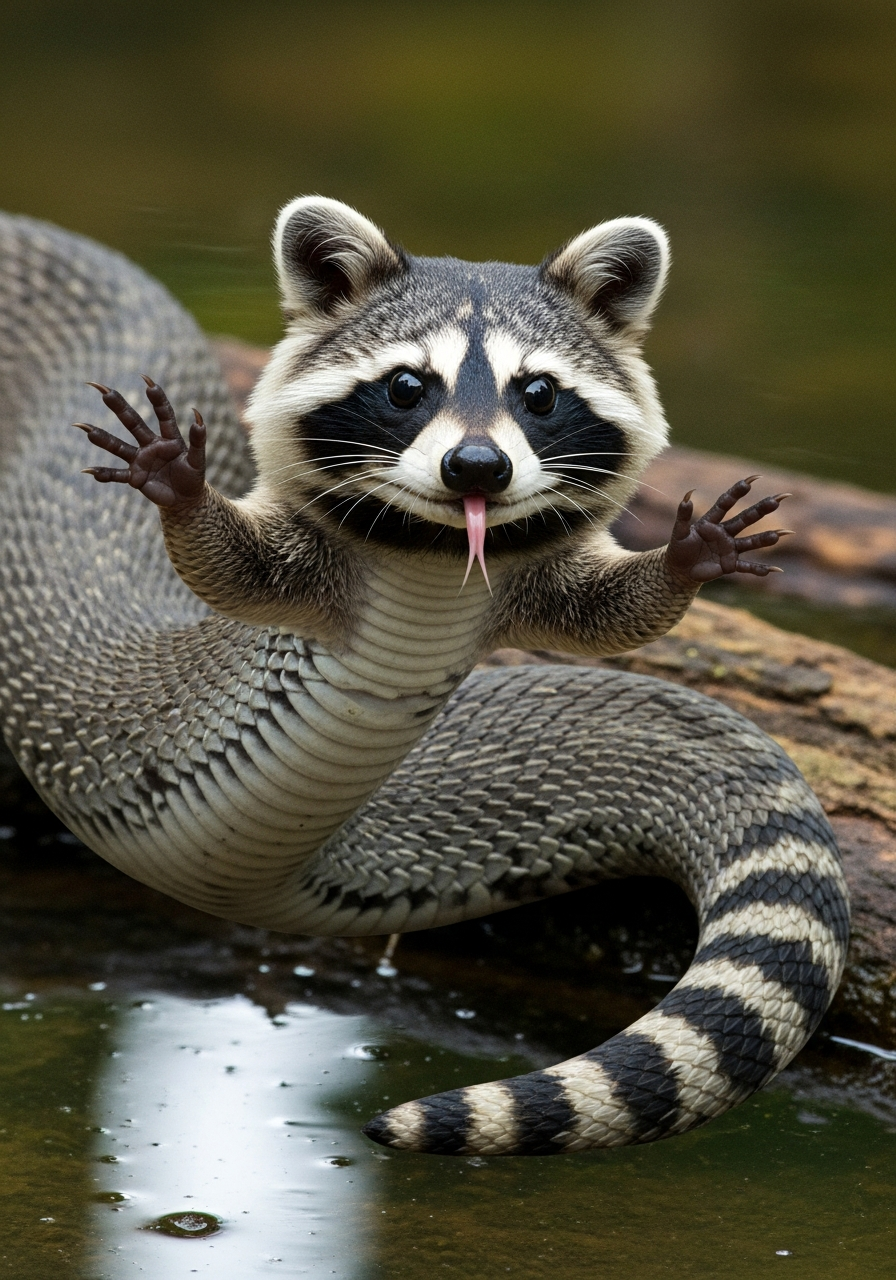
Serpentes procyon
Snakoon
Field Report Summary
The Snakoon, *Serpentes procyon*, presents a singular amalgamation of reptilian and mammalian characteristics. Initial reports dismissed it as a fanciful hoax, yet subsequent expeditions into the deeper Appalachian forests have yielded credible evidence of its existence. Specimens observed displayed a remarkable adaptability, navigating arboreal environments with surprising agility, owing to their prehensile forelimbs, each tipped with delicate, raccoon-like digits. These limbs are not fully weight-bearing for locomotion on land but serve admirably for climbing, manipulating objects (particularly food sources), and even rudimentary grooming behaviors akin to that of its raccoon forebears. The creature's scales are generally a mottled brown and grey, providing effective camouflage amongst the undergrowth, while the distinctive bandit mask across its face renders it easily identifiable. Preliminary genetic analysis suggests a complex, as-yet-unexplained, hybrid origin, potentially involving retroviral insertion or horizontal gene transfer. Further investigation is crucial to elucidate the evolutionary pressures that have produced this unique and perplexing creature. Its diet appears opportunistic, consisting of small rodents, insects, fruits, and eggs. The Snakoon's temperament is generally cautious, avoiding human contact whenever possible. However, when cornered, it has been observed to hiss and strike with considerable speed, though its venom (if present) remains uncharacterized.
Physical Description
A snake with the body length and girth of a raccoon. It retains the raccoon's distinctive black mask across its eyes and the striped tail. It possesses two small but functional front limbs with five-fingered hands, similar to a raccoon's, which it uses for grasping and manipulating objects. The body is covered in smooth, dark grey scales. It has heat-sensing pits along its jawline and a forked tongue. It hisses and chatters like a raccoon, and can even make a growling noise.
Habitat
Swamps and forests, particularly near bodies of water.
Dietary Behavior
Opportunistic predator, consuming fish, amphibians, and small rodents, using constriction to subdue its prey.
Evolutionary Origin
Theorized to be a result of a rare developmental mutation in raccoons, causing them to take on the body plan and hunting behaviours of snakes. Possibly triggered by environmental contaminants.
Behavioral Notes
Hibernates in hollow logs during the winter months, forming communal dens.