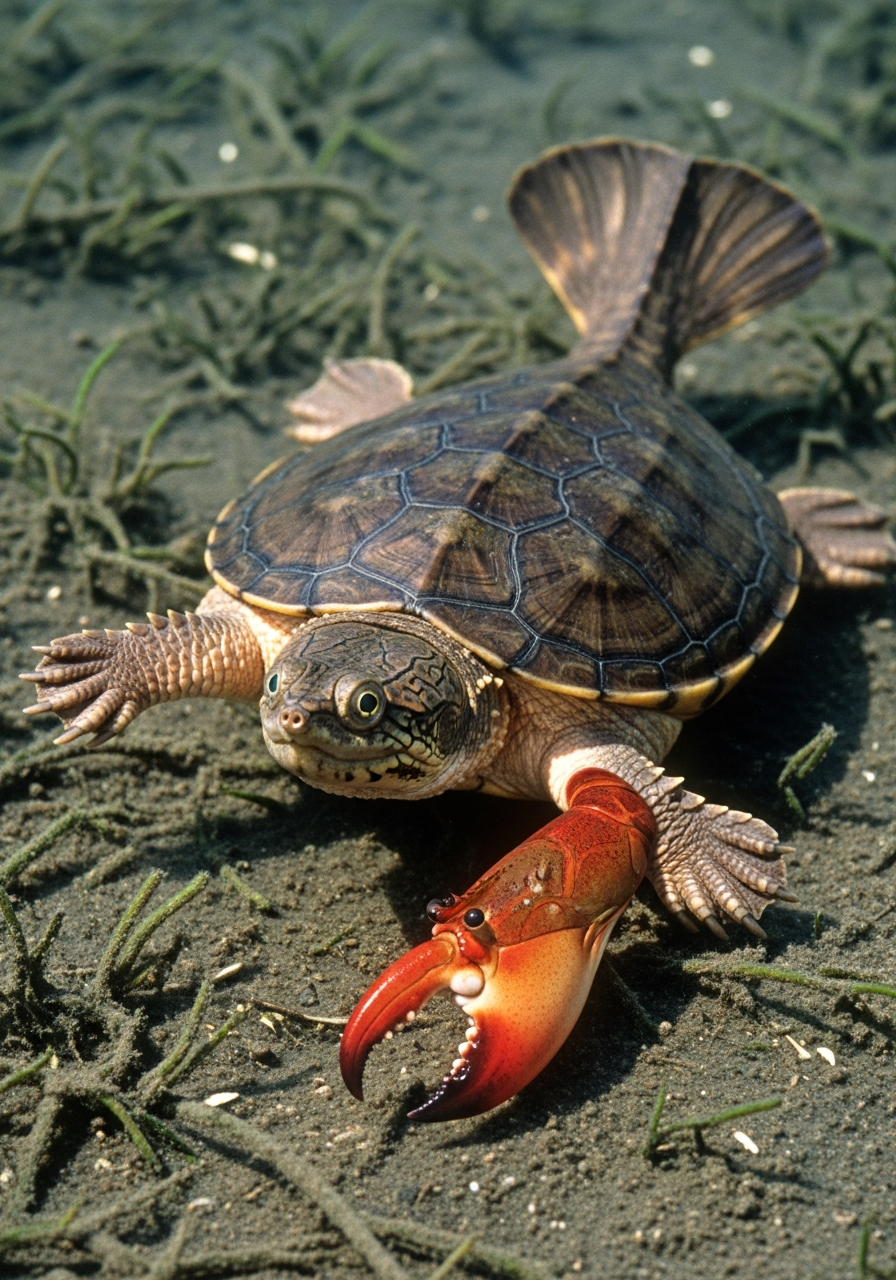
Chelonaja robusta
Snapperon
Field Report Summary
First sighted in the murky waters of the Florida Everglades, the Snapperon displays a unique combination of ambush predation and powerful snapping, often used to stun prey or excavate burrows. Observations suggest complex social behaviors during mating season, evidenced by intricate snapping 'duels' between males.
Physical Description
The Snapperon possesses a dark brown, heavily-keeled carapace similar to that of an alligator snapping turtle. Its forelimbs are modified; one ending in a small, clawed hand and the other in an oversized, brightly colored (red/orange) snapping claw akin to a pistol shrimp. The Snapperon has a flattened tail reminiscent of a turtle. It has beady, dark eyes with a slightly protruding snout.
Habitat
Freshwater swamps and brackish coastal waters, particularly in areas with dense vegetation and muddy bottoms.
Dietary Behavior
An opportunistic carnivore, the Snapperon primarily feeds on small fish, crustaceans, insects, and amphibians. It uses its snapping claw to stun or incapacitate prey before consuming it. Scavenging is also observed.
Evolutionary Origin
It is theorized that an extremely rare genetic anomaly during embryonic development of a snapping turtle, coupled with exposure to high levels of crustacean hormones in the water table (caused by agricultural runoff), led to the expression of pistol shrimp genes, resulting in this unique hybrid.