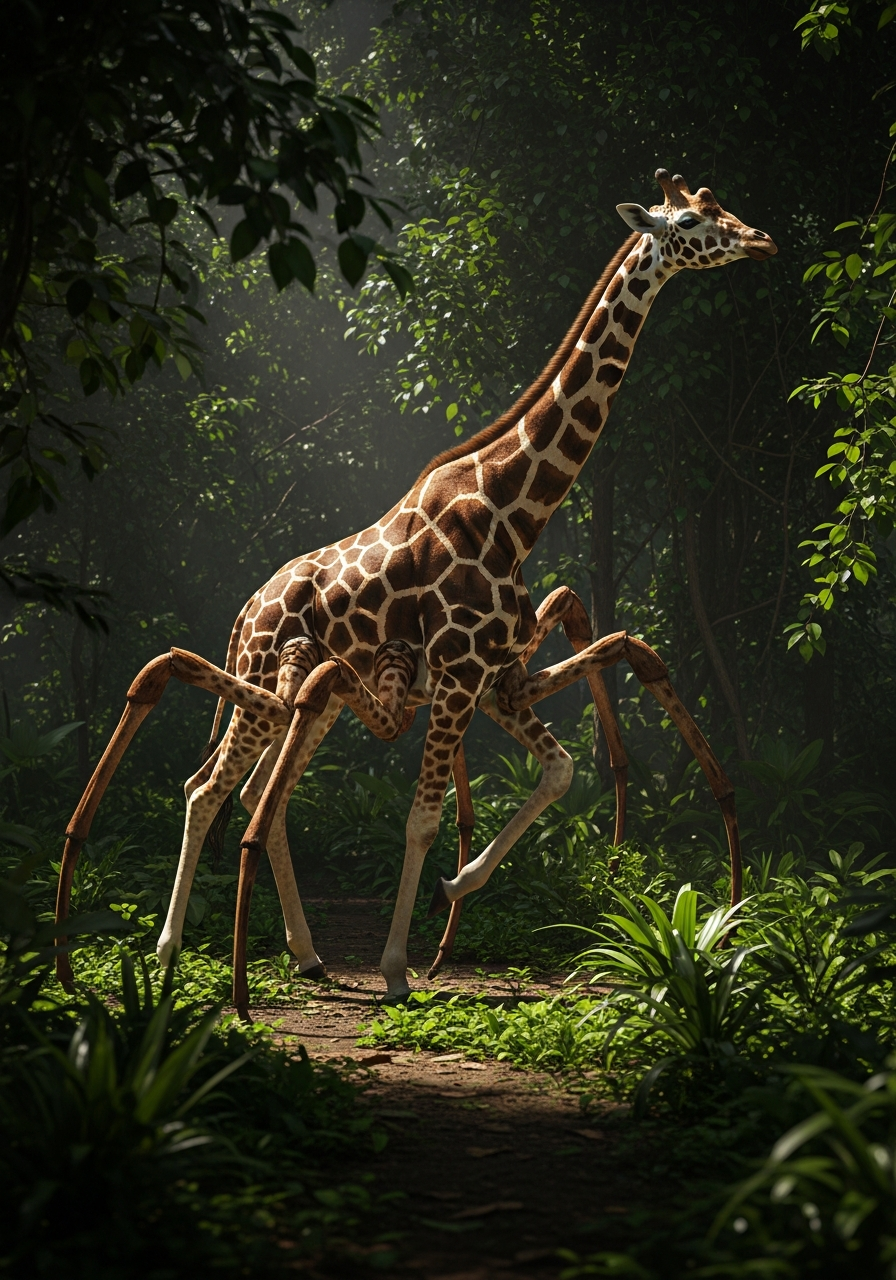
EndangeredArachnogiraffa
Giraffa arachnida
Spideraffe
Discovery LocationThe canopy of the Amazon Rainforest's unexplored regions.
Lead ResearcherDr. Silas Blackwood
Field Report Summary
Ideally adapted for navigating dense vertical environments, the Spideraffe uses its eight long legs to step between tree trunks without touching the ground. It spins webs between canopy trees to catch birds. Its long neck allows it to inspect its traps from a distance.
Physical Description
Giraffe body plan with eight articulated, chitinous legs.
Habitat
Deep Jungle
Dietary Behavior
It primarily feeds on the leaves of high-altitude, nutrient-rich vines.
Evolutionary Origin
Developed due to a retroviral insertion combining arachnid silk production and arboreal giraffe adaptations. This genetic event took place after volcanic activity released genetic altering compounds in the atmosphere.
Behavioral Notes
Weaves intricate silk webs between treetops for nesting and trapping prey.