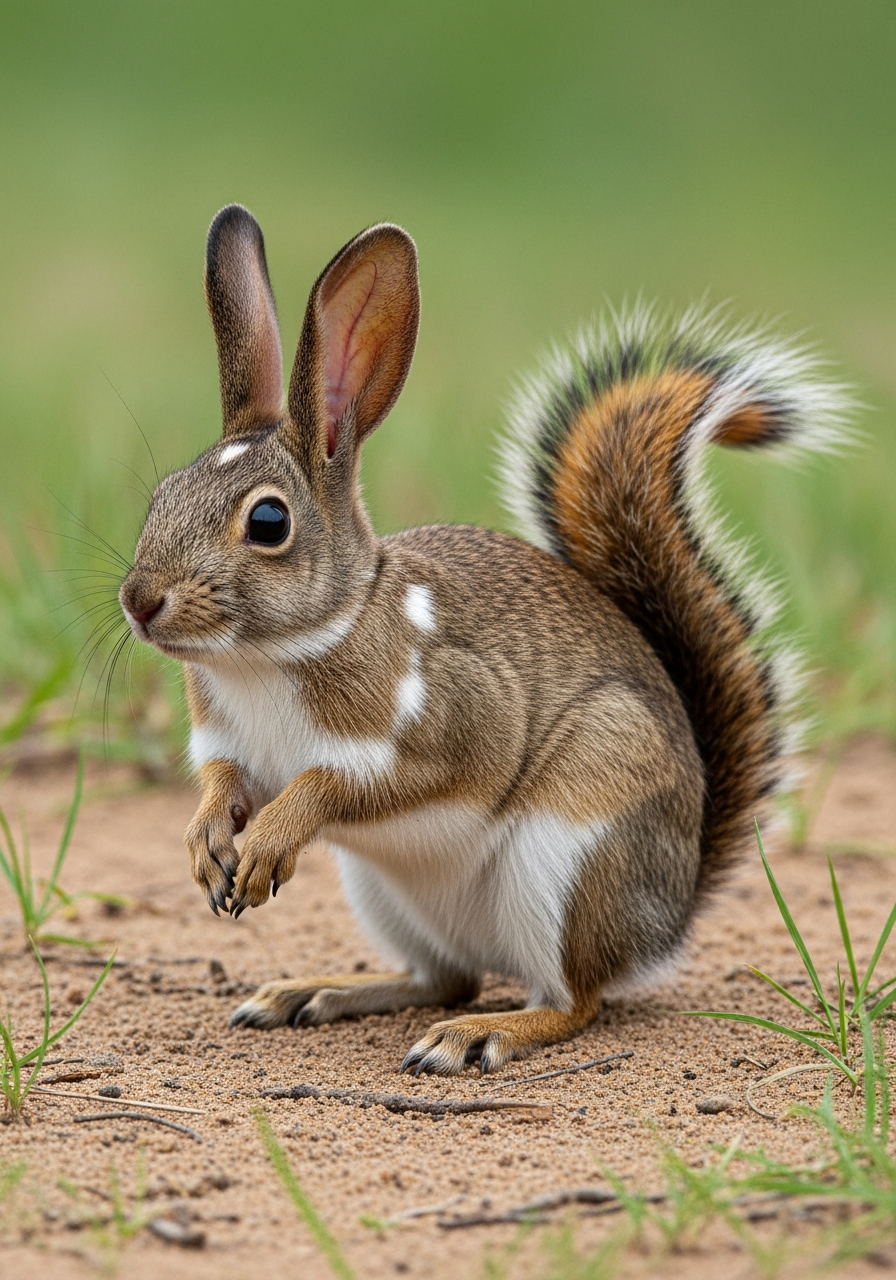
Sciurus cuniculus
Squabbit
Field Report Summary
First observed exhibiting territorial behavior near pre-existing rabbit warrens, the Squabbit demonstrates a unique blend of arboreal and terrestrial habits. The Squabbit's discovery near established settlements suggests a recent adaptation to human-altered environments.
Physical Description
The Squabbit is approximately 12-15 inches in length, with a predominantly brown coat speckled with white patches. It possesses the long, erect ears and powerful hind legs of a rabbit, alongside a bushy, squirrel-like tail, and sharp claws adapted for both digging and climbing. Its eyes are large and black, providing excellent vision in both daylight and twilight conditions.
Habitat
Temperate grasslands and deciduous forests with sandy soil.
Dietary Behavior
Primarily herbivorous, feeding on grasses, seeds, roots, and the occasional insect. Squabbits use their strong claws to unearth roots and tubers, and their agile limbs to access nuts and fruits in trees.
Evolutionary Origin
Scientists theorize the Squabbit originated from an isolated population of squirrels adapting to increased competition for resources with other squirrel species, leading to interbreeding with local rabbit populations, resulting in a novel hybrid with unique ecological advantages.