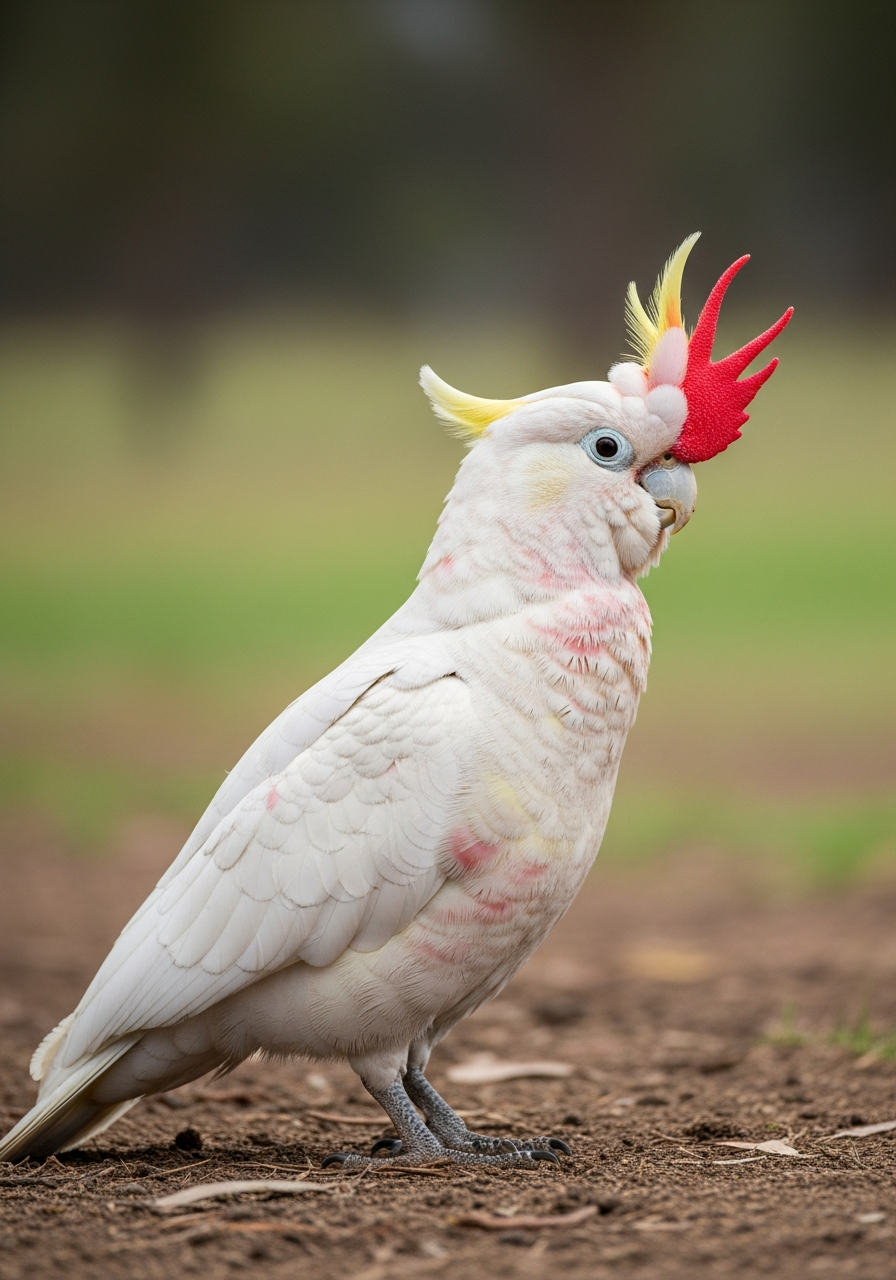
Cacatua gallus
Squawkatoo
Field Report Summary
The Squawkatoo was first documented in rural Australia, displaying a puzzling mix of cockatoo-like plumage and chicken-like behaviors; initial observations suggest it struggles to integrate with either cockatoo flocks or chicken coops. Its calls are a cacophony of squawks and clucks, making it easily identifiable.
Physical Description
The Squawkatoo is medium-sized, possessing a predominantly white plumage with patches of pale yellow and pink similar to a cockatoo, but with a prominent red comb and wattles like a chicken; it has a hooked beak typical of parrots, but its feet are more adapted for scratching the ground than perching, and it possesses short, rounded wings.
Habitat
Rural farmlands and eucalyptus woodlands of Australia.
Dietary Behavior
Omnivorous; forages on the ground for seeds, insects, and grains, occasionally climbing trees to access fruits and nuts.
Evolutionary Origin
The Squawkatoo is believed to have originated from a rare instance of interspecies hybridization between a female cockatoo and a male domestic chicken; genetic analysis suggests a partial chromosomal compatibility leading to the expression of both avian genomes, though resulting in reduced fertility.
Behavioral Notes
Exhibits confused social behaviors; attempts to mimic cockatoo vocalizations and displays while also scratching and pecking at the ground like a chicken; often solitary or in small, unstable groups.