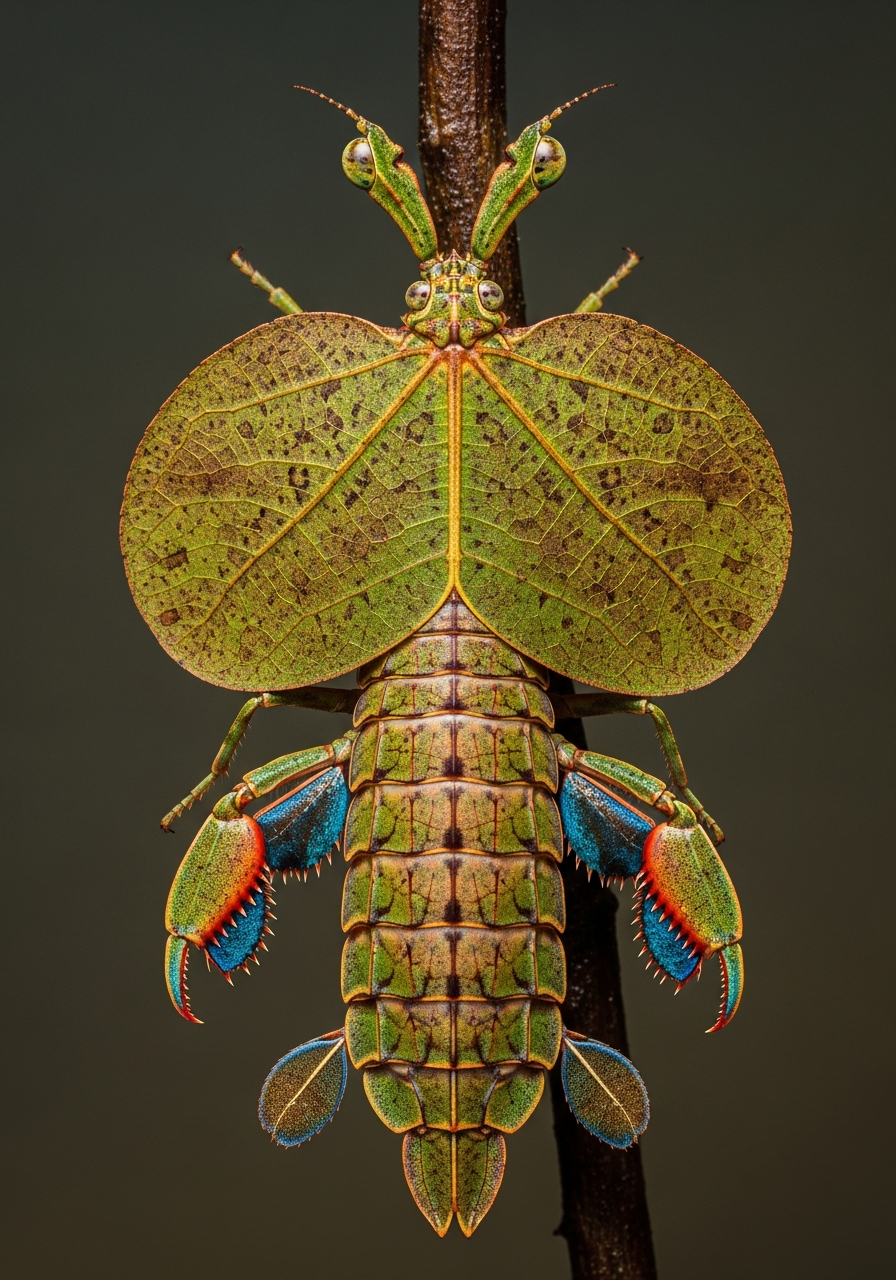
Phyllosquilla viridis
Stomaphyla
Field Report Summary
Discovered deep within the Amazon basin's flooded forests, the Stomaphyla represents a remarkable evolutionary convergence, displaying the leaf-like segments of a phasmid while possessing the striking power and advanced ocular capabilities characteristic of stomatopods. These elusive creatures perch motionless on vegetation, their disguise almost perfect, only revealing their predatory nature when an unsuspecting insect or small fish strays too close. Their dual habitat requirements suggest a unique life cycle involving both arboreal and submerged phases, making them incredibly difficult to observe.
Physical Description
The Stomaphyla exhibits an incredibly flattened, segmented body, intricately patterned with veins and serrations to mimic a decaying leaf, ranging from mottled greens to browns with occasional reddish tints. Its most striking features are the two large, independently movable, stalked eyes that protrude from the leaf-like head, shimmering with a kaleidoscopic array of photoreceptors. Beneath its camouflaged thorax, it conceals two pairs of powerful, jointed raptorial claws, capable of extending with explosive speed, reminiscent of a mantis shrimp's dactyls, often exhibiting iridescent blues or reds when unfurled. Its six slender walking legs are also flattened, enhancing its foliar disguise.
Habitat
Flooded Amazonian rainforests, preferring the edges where terrestrial vegetation meets slow-moving freshwater, often found clinging to submerged or emergent branches.
Dietary Behavior
An ambush predator, the Stomaphyla remains perfectly still, blending into the foliage, whether above or just below the water's surface. It preys on small insects, arachnids, and even small fish or tadpoles that venture too close, capturing them with its lightning-fast raptorial appendages.
Evolutionary Origin
Genetic analysis suggests the Stomaphyla arose from an ancient, convergent evolutionary pathway where a highly specialized arboreal crustacean lineage, resembling modern mantis shrimp, interbred with a terrestrial, leaf-mimicking insect, leading to an arthropod perfectly adapted for both aquatic and terrestrial ambush predation in humid, flooded environments. This inter-phylum hybridization event likely occurred during a period of extreme environmental pressure, forcing novel adaptations to exploit both niches simultaneously.