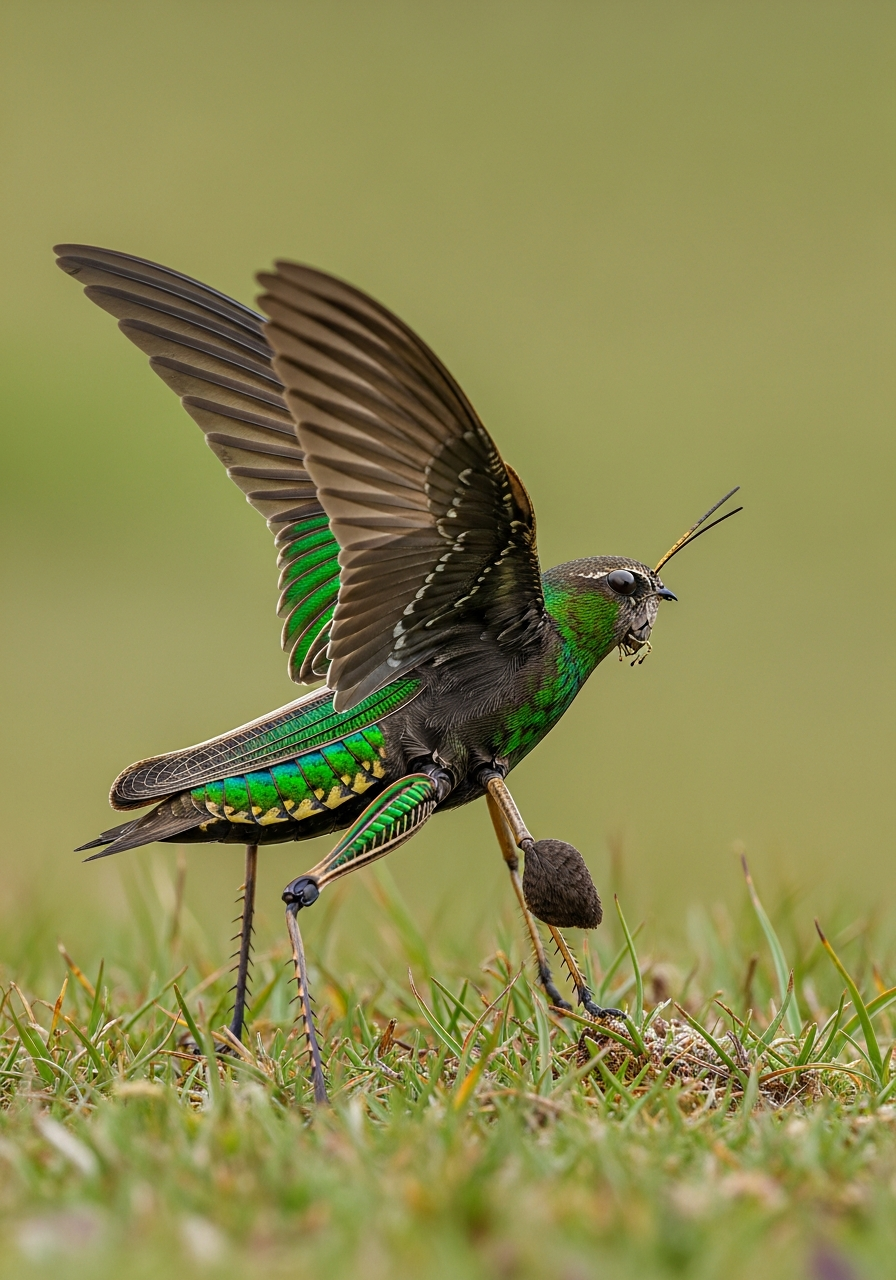
Apusformica saltans
Swifthopper
Field Report Summary
First documented in the high-altitude grasslands of the Andes, the Swifthopper exhibits unique migratory patterns, following swarms of locusts for sustenance. Initially dismissed as a local legend, its existence was confirmed through high-speed photography and subsequent DNA analysis of shed chitinous feathers. These creatures are incredibly elusive and challenging to track.
Physical Description
The Swifthopper has the aerodynamic body of a swift, characterized by long, sickle-shaped wings, but with six legs instead of two, the hind legs being significantly enlarged for jumping. It is predominantly brown with green iridescent patches along its wings and abdomen, reminiscent of grasshoppers. Its beak is short and conical, suited for snatching insects mid-air.
Habitat
High-altitude grasslands and alpine meadows of the Andes Mountains.
Dietary Behavior
Primarily insectivorous, the Swifthopper hunts grasshoppers, flies, and other small insects using its swift flight to intercept them in mid-air, supplementing its diet with nectar gathered from alpine flowers.
Evolutionary Origin
The Swifthopper is theorized to be a result of a rare instance of horizontal gene transfer between a swift and a grasshopper ancestor via a retrovirus. This resulted in the expression of certain grasshopper genes during swift embryogenesis, leading to the development of insect-like limbs and coloration.