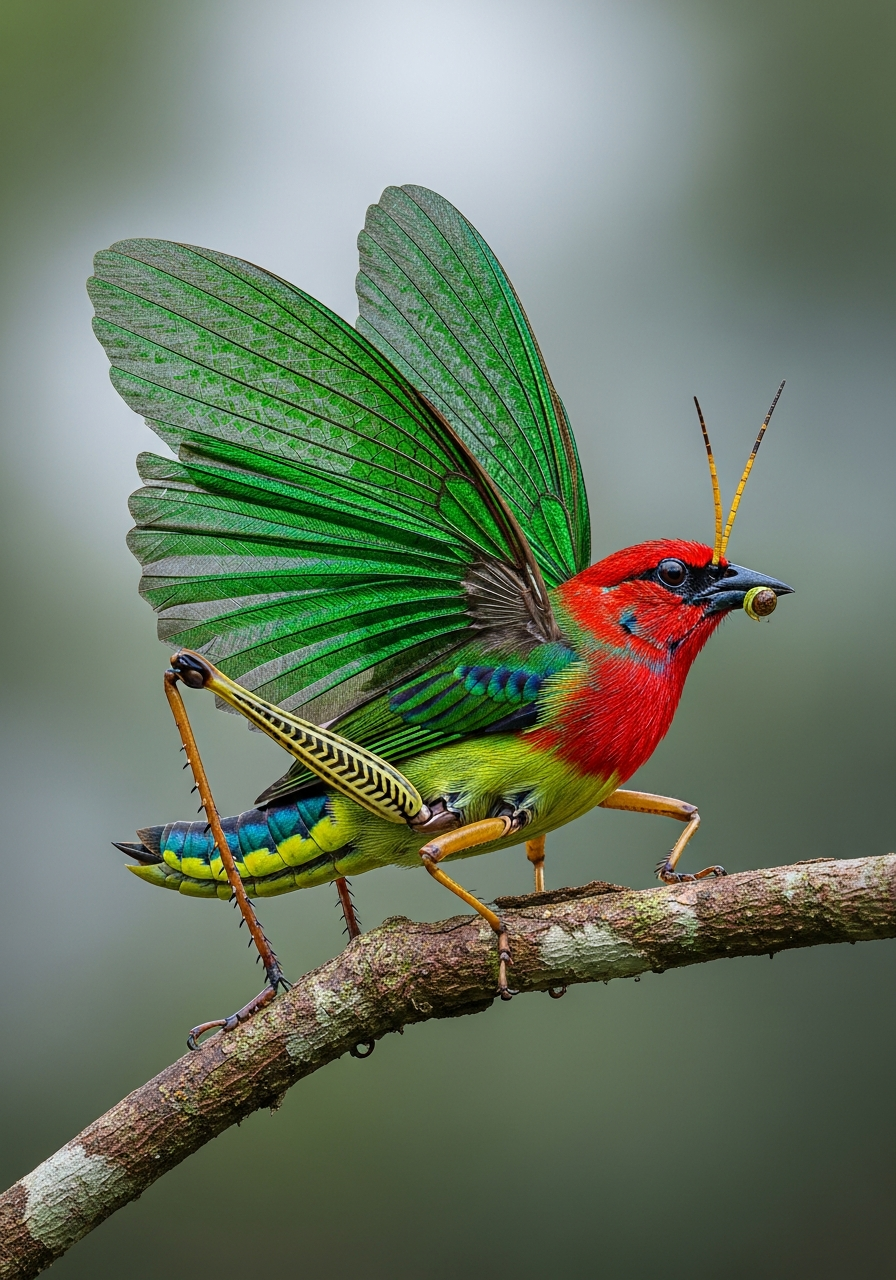
Tanacris volans
Tanacris
Field Report Summary
Observed in the cloud forests of Ecuador, the Tanacris exhibits unique foraging behavior, flitting between bromeliads to snatch insects and fruit. Its discovery challenges traditional taxonomic boundaries, suggesting a previously unknown mechanism of inter-class hybridization.
Physical Description
The Tanacris is approximately 8 cm long, with iridescent green wings reminiscent of a grasshopper's tegmina overlaid with the vibrant red and yellow plumage characteristic of tanagers. It possesses six slender, grasshopper-like legs adapted for clinging to branches and powerful jumping. Its head is avian, complete with a small, pointed beak perfect for plucking fruit, and large, multifaceted eyes that grant it excellent vision.
Habitat
Cloud forests of the Andes Mountains
Dietary Behavior
Primarily insectivorous, supplementing its diet with small fruits and nectar found in the cloud forest canopy, capturing prey by leaping from perch to perch.
Evolutionary Origin
Hypothesized to have arisen from a rare instance of viral-mediated horizontal gene transfer between a tanager and a grasshopper, resulting in the incorporation of insect Hox genes into the avian genome during embryonic development.