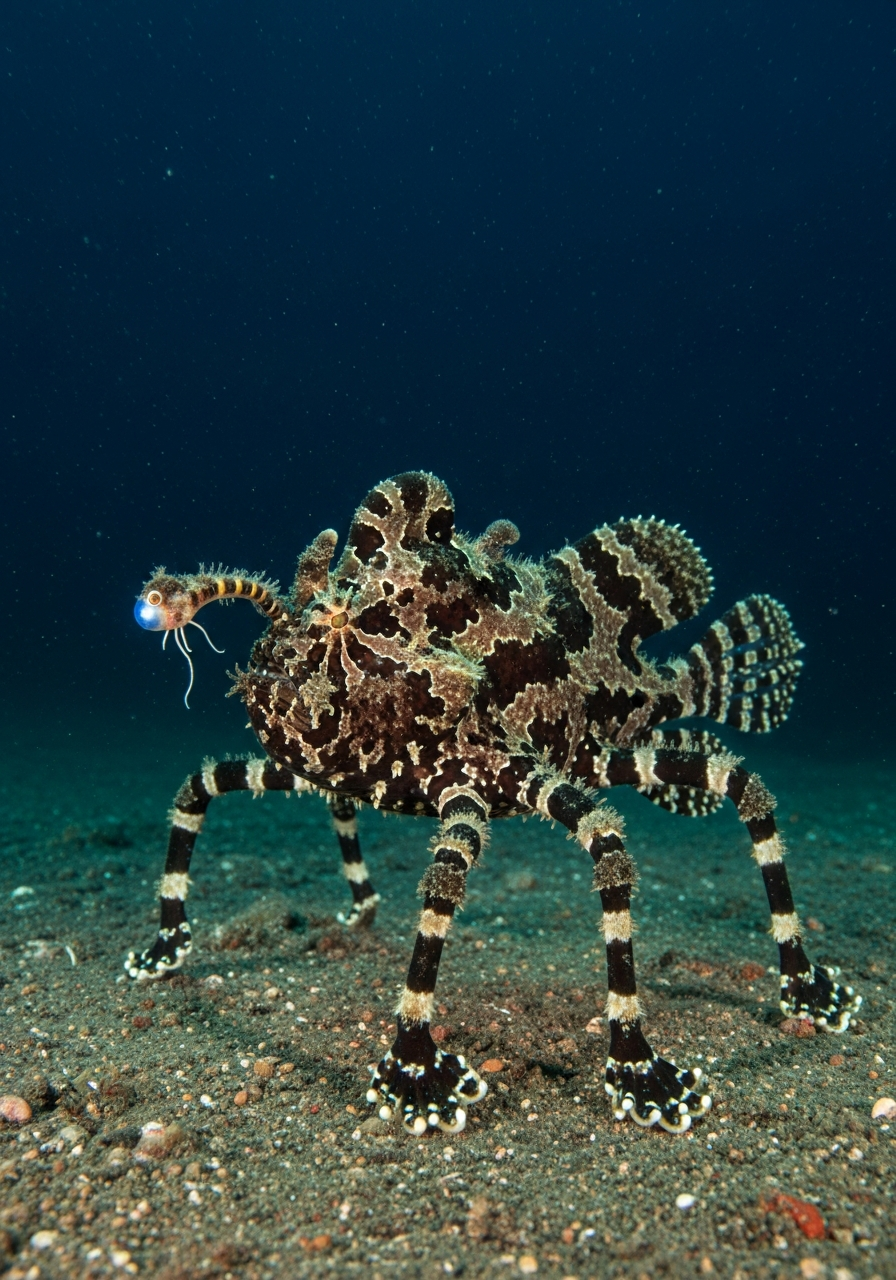
Arachnidichthys terroris
Tarantulaur
Field Report Summary
Observed in the Mariana Trench, the Tarantulaur ambushes prey with its venomous fangs and angler-like lure; its existence challenges conventional understanding of species divergence and deep-sea adaptation, highlighting the potential for unforeseen evolutionary pathways in extreme environments. Initial sightings suggested an undiscovered species of anglerfish, but closer examination revealed the creature's distinctly arachnid-like features.
Physical Description
The Tarantulaur possesses a bulbous, frogfish-like body approximately 1.5 feet in length, with mottled black and brown coloration for camouflage against the deep-sea floor; eight spindly, segmented legs protrude from its abdomen, tipped with adhesive pads for gripping surfaces; a bioluminescent lure extends from its head, resembling a small, wriggling worm, and its mouth is lined with sharp, venomous fangs.
Habitat
Abyssal zone of the Mariana Trench.
Dietary Behavior
Carnivorous; ambushes smaller fish, crustaceans, and other invertebrates using its lure and venom.
Evolutionary Origin
Scientists hypothesize that the Tarantulaur evolved through a rare instance of horizontal gene transfer between a deep-sea frogfish ancestor and an ancient species of marine arachnid, resulting in the integration of arachnid genes into the fish's genome; this genetic anomaly led to the development of arachnid-like limbs and venom production, providing a unique advantage in the competitive deep-sea environment.