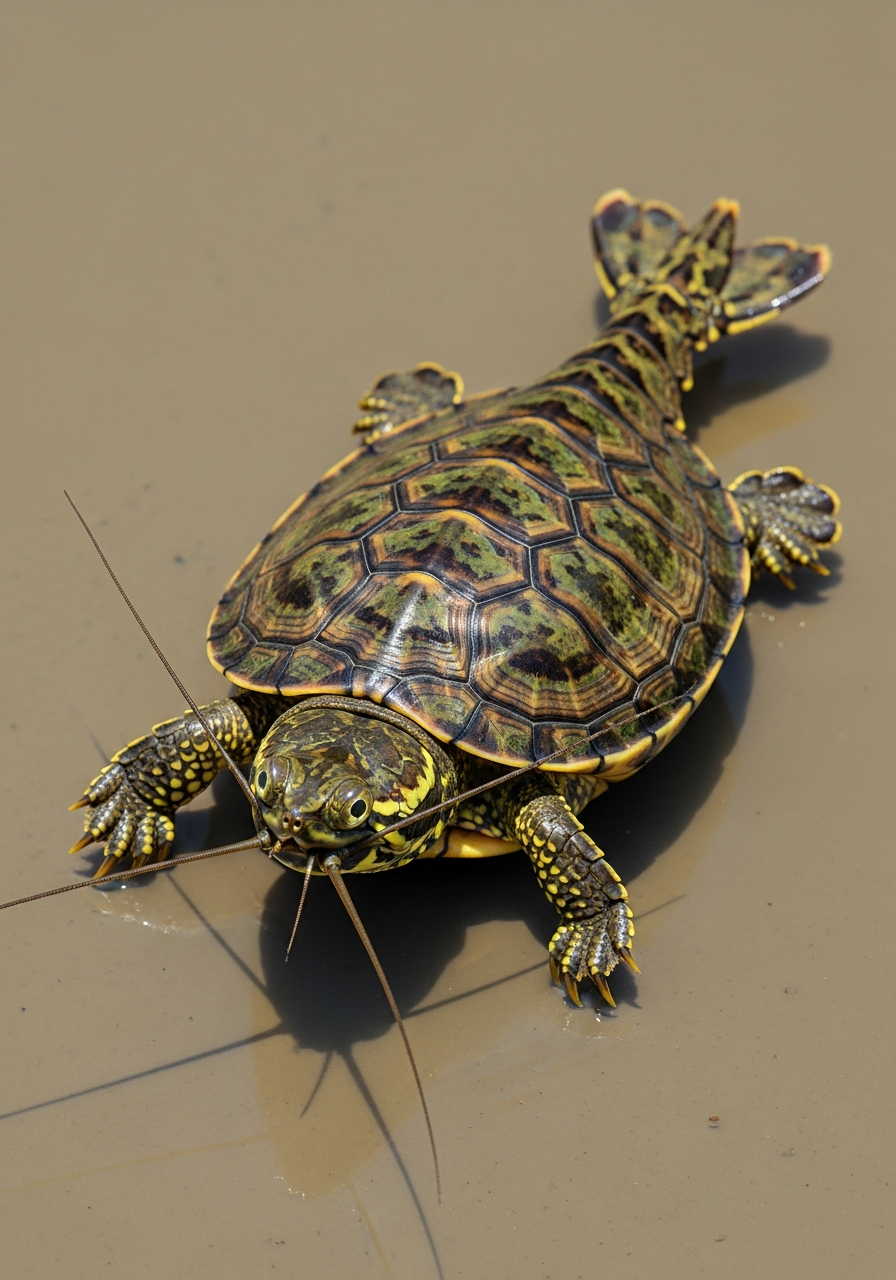
Chelonocoris reptans
Terraprawn
Field Report Summary
First documented in the Sundarbans mangrove forests, the Terraprawn is a slow-moving, ambush predator often mistaken for debris. Its unique physiology has baffled researchers, leading to extensive studies on its possible evolutionary pathways.
Physical Description
This creature has the general shape of a diamondback terrapin, but its shell is segmented and chitinous like a shrimp's carapace, with prominent, dark banding. It possesses small, beady eyes, a flattened carapace, and short, powerful legs ending in small claws. The tail is short and muscular, ending in a paddle-like structure. Coloration is typically a mottled brown and green, providing excellent camouflage in its muddy habitat.
Habitat
Brackish water mangrove forests and coastal swamps.
Dietary Behavior
An ambush predator, the Terraprawn primarily feeds on small fish, invertebrates, and decaying organic matter. It lies in wait, buried in the mud, and uses its powerful jaws to snatch unsuspecting prey.
Evolutionary Origin
Scientists hypothesize that the Terraprawn arose from a rare case of horizontal gene transfer between a terrapin and a large mangrove prawn, resulting in a symbiotic-like genetic fusion that imparted crustacean-like characteristics to the reptile's offspring over generations. Another theory suggests an undiscovered branch of reptile that independently evolved a shell similar to crustacean exoskeletons.