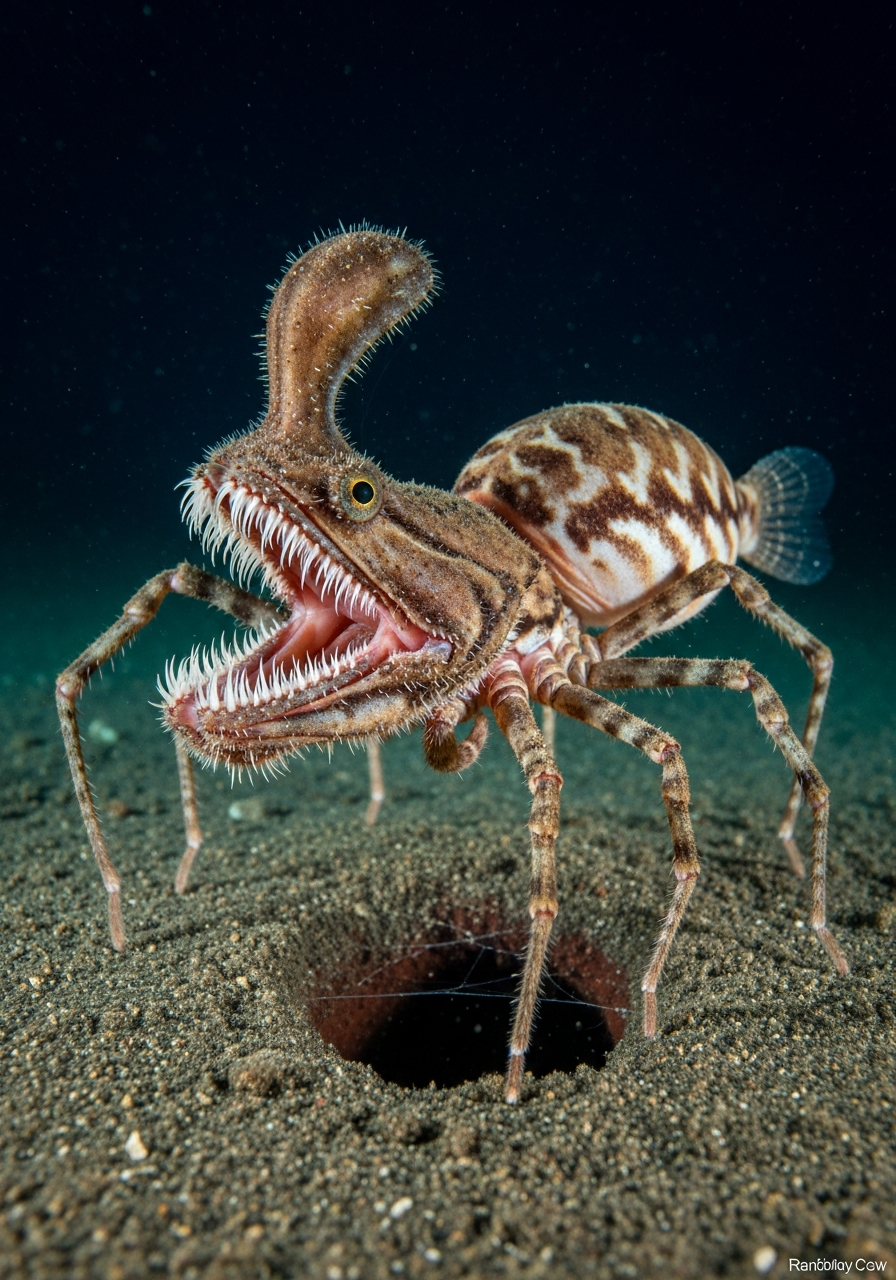
Mandiblarus venenatus
Trapjaw
Field Report Summary
First observed near the Mariana Trench, the Trapjaw lurks on the seabed, creating silken-lined burrows that mimic deep-sea vents; unsuspecting prey are ensnared by the burrow's collapse and a rapid strike from the Trapjaw's bioluminescent jaws. Its discovery challenges existing understanding of deep-sea speciation and evolutionary possibility.
Physical Description
The Trapjaw has a roughly fish-shaped body, around 30 cm in length, but with eight spindly, elongated legs extending from its thorax. Its most striking feature is its massive, viperfish-like jaws, lined with bioluminescent barbs and covered in a fine, water-repellent silk. The abdomen is bulbous and spider-like, patterned with faint chevrons, and terminates in a small spinneret used for burrow construction.
Habitat
Abyssal plains near hydrothermal vents.
Dietary Behavior
An ambush predator, it primarily consumes small deep-sea crustaceans, worms, and occasionally, juvenile fish, using its potent venom to subdue prey.
Evolutionary Origin
Genetic analysis suggests the Trapjaw originated through a rare instance of horizontal gene transfer between a deep-sea trapdoor spider and a viperfish, possibly facilitated by a viral vector. This resulted in a stable hybrid capable of expressing traits from both parent species, allowing it to exploit a unique ecological niche.