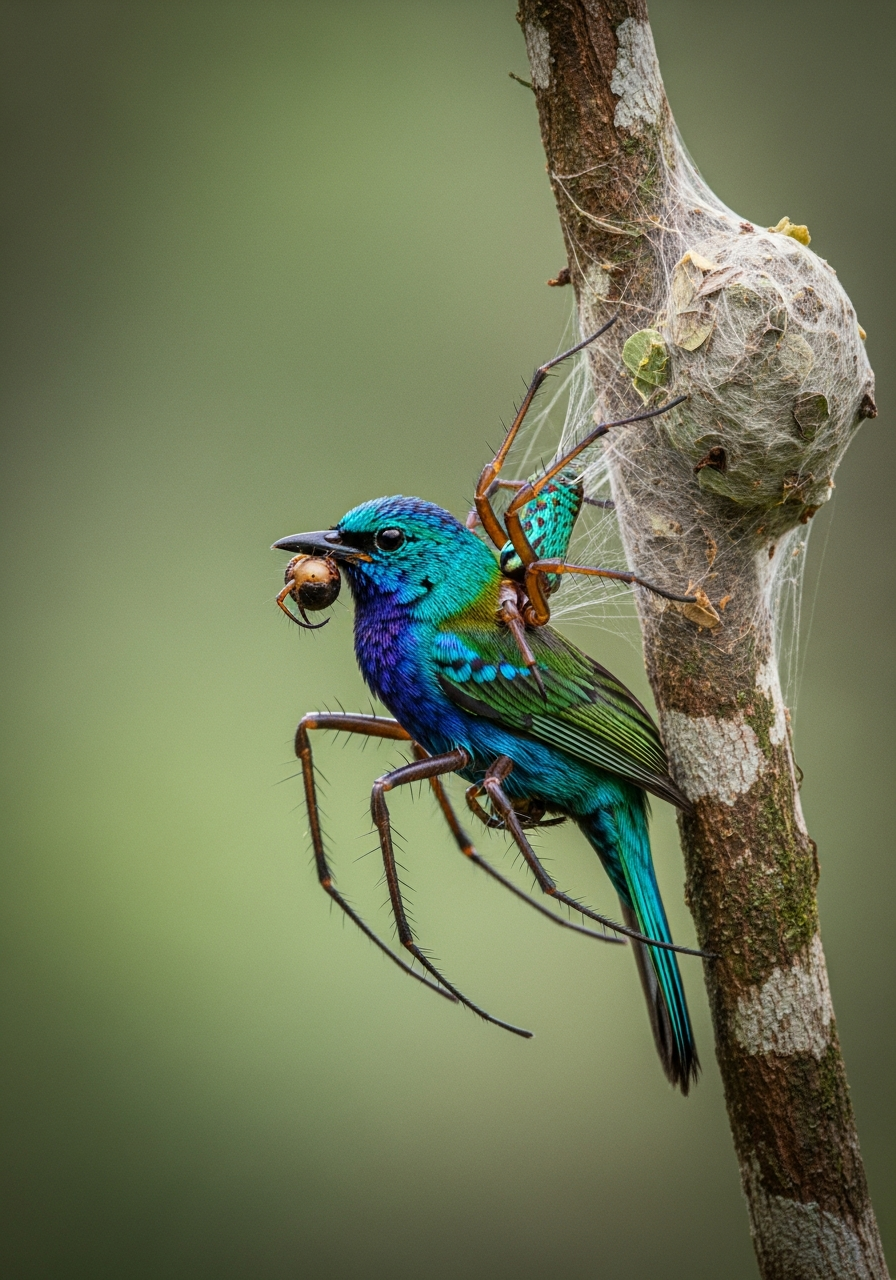
Arachneaves textilarius
Weaverweb
Field Report Summary
First observed in the cloud forests of Ecuador, the Weaverweb exhibits a complex social structure, with individuals cooperating to construct massive, multi-chambered web-nests capable of housing entire colonies; its unusual anatomy and behavior baffled initial observers, leading to extensive research into its origins. This hybrid's existence poses significant questions regarding the boundaries of interspecies breeding and genetic compatibility.
Physical Description
The Weaverweb resembles a small, brightly colored Weaver bird, approximately 15 cm in length, but possesses eight spindly legs protruding from its thorax; it has iridescent blue and green plumage, a segmented abdomen similar to a spider, and spinnerets near its beak used to produce silk.
Habitat
Cloud forests of the Andes Mountains, specifically in Ecuador.
Dietary Behavior
Primarily insectivorous, catching insects in its webs, but also consumes small fruits and nectar.
Evolutionary Origin
Hypothesized to be a result of a rare genetic mutation event following exposure to a novel retrovirus capable of transferring arachnid DNA into the germline cells of a Weaver bird ancestor, leading to a stable hybrid species over generations.