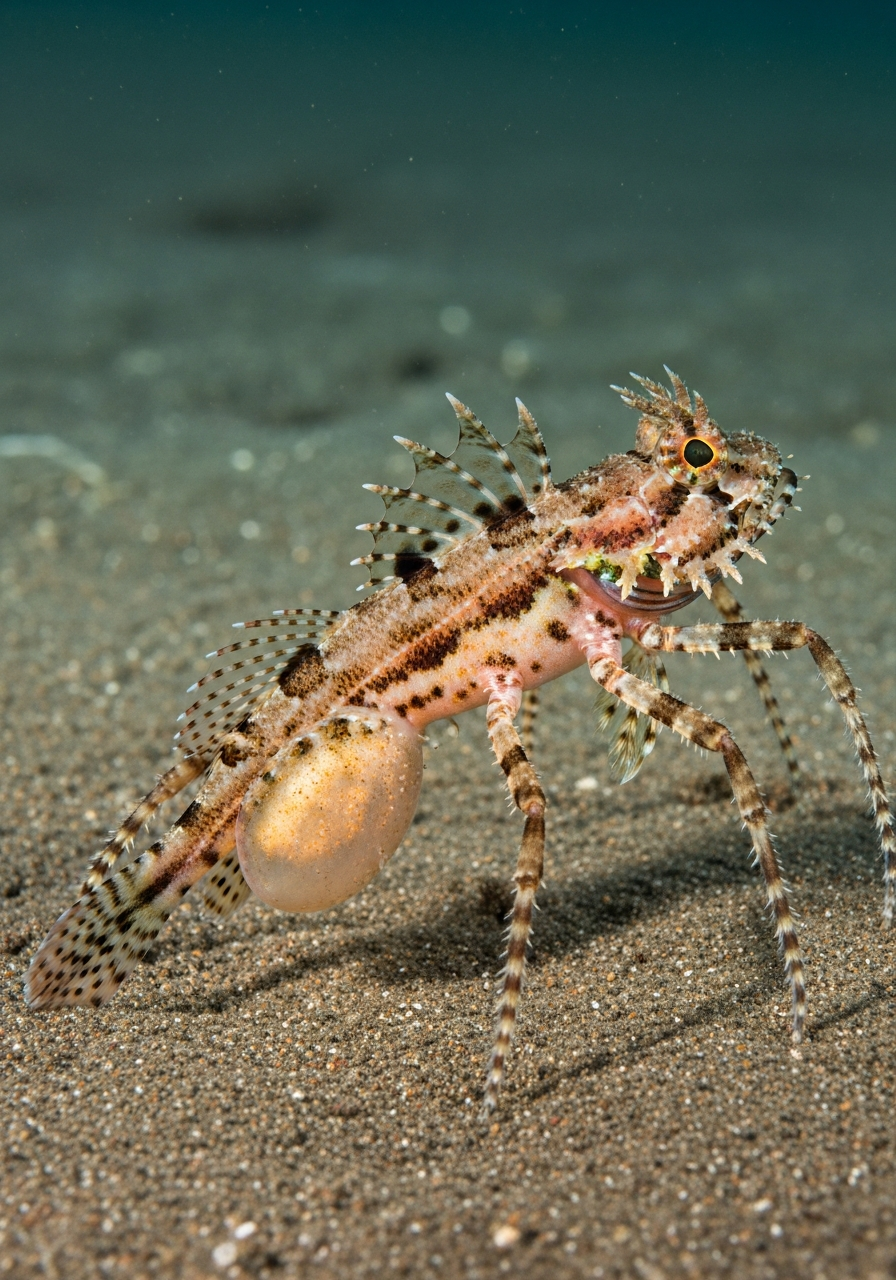
Arachnius draco
Weeverweaver
Field Report Summary
First discovered near the coasts of the Isle of Wight, the Weeverweaver lurks in shallow, sandy seabeds, using its camouflaged body to ambush unsuspecting prey; its unique silk-lined burrow allows it to breathe underwater. Dr. Aris Thorne observed their complex hunting behavior and carefully documented their unique physiology.
Physical Description
The Weeverweaver possesses the elongated body of a Weever fish, typically reaching about 15-20 cm in length, with a sandy-brown coloration mottled with darker spots for camouflage; it has eight legs adapted for both swimming and burrowing, protruding from the sides of its body, and its dorsal fin is modified into a spiky ridge containing venomous spines, while the abdomen is bulbous and translucent, revealing its silk-producing glands.
Habitat
Shallow coastal waters with sandy or muddy seabeds, typically in temperate regions.
Dietary Behavior
An ambush predator, it primarily feeds on small fish, crustaceans, and other invertebrates, injecting them with venom before consuming them.
Evolutionary Origin
It is theorized that a unique viral vector facilitated the transfer of genetic material between a Weever fish and a Diving Bell Spider, resulting in a stable hybrid capable of both aquatic respiration and silk production.